

We start New Year’s Eve highly motivated with good resolutions. How sustainably these are implemented often becomes apparent by mid-January. Whether you’re still in the thick of it or your first good intentions have already been abandoned, turning them into habits isn’t so easy. It works best in small steps. We’ll explain how to achieve this and have three ideas for you.
How can you establish good habits?
Habits, whether good or bad, are unconscious actions we impulsively “just do,” such as adding sugar to our coffee or snacking while watching TV. The brain permanently stores these actions and releases certain neurotransmitters when we perform them. It “rewards” us with positive feelings when we give in to the impulse. This is why it’s so difficult to change habits permanently. The underlying mechanism is powerful, and change requires effort. Especially in stressful situations, you may revert to learned behaviors. Therefore, if you want to establish a new habit permanently, you need the genuine intention to change, realistic goals that you can actually achieve, and many repetitions of the implementation.1, 2
How long does it take to establish good habits?
You may have heard that it takes 66 days for a resolution to become a habit. We’d love to give you an exact number so you can tick something off your calendar. However, research yields varying results depending on what was studied. Many factors play a role: your personality, external conditions, and the habit itself. Setbacks are normal. So, if you want to try one or more of our suggestions and it doesn’t work at first, remember: when old habits creep back in, it’s not a failure, but rather the program your brain has stored. It takes time and repetition to “overwrite the programming.” So be patient with yourself and proud of small successes.1, 2, 3 This also applies if you try one or more of the following examples.
A common resolution: to eat less sugar.
If you want to get into the habit of eating less sugar, take a look at your current habits and ask yourself: What small steps can you implement right away? For example, do you prefer your coffee or tea with lots of sugar? Try it without. Don’t like it at all? Then reduce it. Spoonful by spoonful, and celebrate each one you manage to skip. But you shouldn’t just snack less. Sugar is also “hidden” in many processed foods.4 Avoid “sugar traps” such as ready-made meals, fruit yogurts, salad dressings, and breakfast cereals. On the ingredient lists of everyday foods, added sugar is hidden behind names such as: Glucose, sucrose, dextrose, sugar syrup, sweet whey powder, barley malt. For snacking, there are a number of healthy alternatives. Fruit is a good choice, either as a snack or, for example, made into moist banana bread – naturally without added sugar. Unsweetened fruit tea is an alternative to sweet drinks. You can flavor water with lemon slices, (frozen) berries, or peppermint. Honey is often touted as a healthy sugar alternative, but this is only partially true. While the natural product does contain traces of vitamins and minerals, it provides the same amount of energy as table sugar.4, 5
An unusual resolution: “Veganuary” – an exclusively vegan diet for one month in January.
If your diet has previously consisted of a mixed diet including meat, switching to veganism is a radical change. Perhaps it’s enough to start by trying out whether a vegan diet is right for you. The idea behind “Veganuary” (a portmanteau of “vegan” and the English word “January”) is to try living vegan for a month and abstaining from all animal products. This self-experiment allows you to see what you can easily implement and perhaps want to maintain as a habit. However, the body can absorb some nutrients from animal products more efficiently than from plant-based ones. Even for people who “only” eat a vegetarian diet, it can be beneficial to take dietary supplements in certain cases. For vegans, this is sometimes even essential, for example, with vitamin B12.6, 7
Vitamin B12 for energy metabolism
The body needs vitamin B12 for energy metabolism, the formation of blood cells, and nerve function. Sufficient amounts are found exclusively in animal-based foods. According to current knowledge, adequate intake is only possible with a purely vegan diet through the continuous use of a nutrient supplement; otherwise, a vitamin B12 deficiency is likely. When choosing supplements, look for natural production methods and high-quality ingredients.6, 7, 8
Best New Year’s resolution for your health: Eat more fruit and vegetables
The beauty of this resolution is that you don’t have to give up anything; instead, you can simply add something healthy to your diet – in the form of more fruits and vegetables that you enjoy. Fruits and vegetables are natural sources of vitamins and minerals, as well as phytochemicals and fiber. To ensure you get enough of these, make your diet colorful with as many different varieties as possible. Speaking of colorful: Did you know that the color of a fruit can give you a clue about the vital nutrients it contains? Many red and deep black fruits, for example, contain anthocyanins. These natural pigments belong to the group of phytochemicals and are found in particularly high concentrations in fruits such as sour cherries, elderberries, and wild blueberries. Anthocyanins have a protective effect on plants, protecting them, for example, from damage caused by UV radiation. In the human body, anthocyanins can protect cells by neutralizing free radicals.9
Good habits for more fruit and vegetables
The German Nutrition Society (DGE) recommends at least five portions of fruit and vegetables per day. One portion could be, for example, an apple, two handfuls of berries, or a bell pepper.10 These can be incorporated gradually, one portion at a time, or combined in many different ways. After a little chopping, you have a healthy snack plate that you can help yourself to anytime. Make your main meals colorful, too – as varied as possible. For example, a vegetable stir-fry with yellow bell pepper, tomato, and broccoli. For dessert, natural yogurt with wild blueberries.11
Quellen
- Psychology Today. The Science of Habits. https://www.psychologytoday.com/us/blog/brain-wise/201904/the-science-habits, letzter Abruf am 22.12.2025
- Association for Psychological Science. Eric Houstin. Changing Habits for the Long Haul. https://www.psychologicalscience.org/observer/changing-habits-for-the-long-haul, letzter Abruf am 22.12.2025
- British Journal of General Practice. Making health habitual: the psychology of ‘habit-formation’ and general practice. chrome-extension://efaidnbmnnnibpcajpcglclefindmkaj/https://pmc.ncbi.nlm.nih.gov/articles/PMC3505409/pdf/bjgp62-664.pdf, letzter Abruf am 22.12.2025
- Uniklinik RWTH Aachen. Die bittersüße Wahrheit über Zucker. https://www.ukaachen.de/kliniken-institute/mfa-zfa/tipps-und-service/die-bittersuesse-wahrheit-ueber-zucker/#:~:text=%C3%9Cberm%C3%A4%C3%9Figer%20Verzehr%20von%20Zucker%20wird,belasten%20damit%20unseren%20gesamten%20K%C3%B6rper., letzter Abruf am 17.12.2025
- NDR. Zucker: Die größten Irrtümer über Glukose, Honig und Co. https://www.ndr.de/ratgeber/verbraucher/Die-groessten-Irrtuemer-ueber-Zucker,zucker125.html, letzter Abruf am 17.12.2025
- Verbraucherzentrale. Vegetarisch und vegan – einfach so? Was ist zu beachten? https://www.verbraucherzentrale.de/wissen/lebensmittel/gesund-ernaehren/vegetarisch-und-vegan-einfach-so-was-ist-zu-beachten-67601#:~:text=Sie%20sollten%20dann%20bei%20einer%20vegetarischen%20Ern%C3%A4hrung,Omega%2D3%2DFetts%C3%A4uren%2C%20Fols%C3%A4ure%2C%20Jod%20und%20eventuell%20auch%20Eisen., letzter Abruf am 23.12.2025
- Deutsche Gesellschaft für Ernährung e.V. Ausgewählte Fragen und Antworten zu veganer Ernährung. https://www.dge.de/gesunde-ernaehrung/faq/faqs-vegane-ernaehrung/#c8240, letzter Abruf am 17.12.2025
- Deutsche Gesellschaft für Ernährung e.V. Referenzwert Vitamin B12 (Cobalamine). https://www.dge.de/wissenschaft/referenzwerte/vitamin-b12/, letzter Abruf am 17.12.2025
- M³ynarczyk K et al. Bioactive properties of Sambucus nigra L. as a functional ingredient for food and pharmaceutical industry. J Funct Foods. 2017 Dec 22; 40: 377–390. https://pmc.ncbi.nlm.nih.gov/articles/PMC7185606/, letzter Abruf am 17.12.2025
- Deutsche Gesellschaft für Ernährung e.V. DGE-Ernährungskreis. Obst und Gemüse. https://www.dge.de/gesunde-ernaehrung/gut-essen-und-trinken/dge-ernaehrungskreis/obst-und-gemuese/, letzter Abruf am 17.12.2025
- SWR. Gemüse in allen Farben. So lässt sich gesunde Ernährung leicht umsetzen. https://www.swr.de/leben/gesundheit/abwechslungsreich-essen-gemuese-in-allen-farben-100.html, letzter Abruf am 17.12.2025
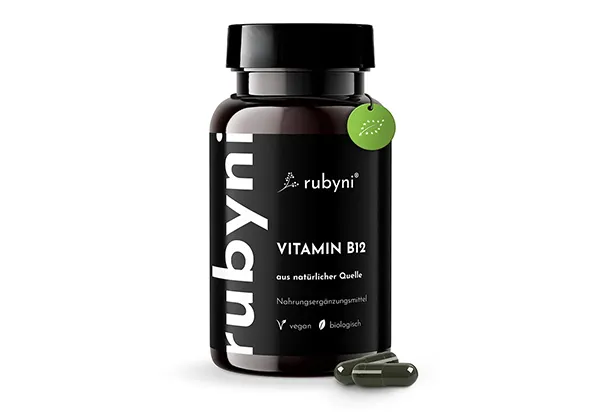
Vitamin B12 from a natural source
rubyni® Vitamin B12
-
Vegan vitamin B12 from shiitake mushrooms with various natural forms of B12
-
Provides energy and reduces tiredness and fatigue.
-
Supports cell division and blood formation
-
It contributes to the normal function of the nervous system and is also essential for your mental health.
- 100% vegan, lactose- and gluten-free, 100% organic