

The Advent season has its own special magic: lovingly decorated windows are illuminated by candlelight, and the air is filled with the scent of freshly baked cookies. You’ve probably already opened the first few doors of your Advent calendar, which is meant to sweeten the wait for Christmas. In our blog post, we’ll show you how the variety of small berries can also enrich your pre-Christmas season.
A moment of pure enjoyment: How these little fruits can sweeten your winter
Even though the berry season in Germany ends in autumn1 at the latest, that doesn’t mean you can only enjoy this delicious fruit in the form of compote or jam in the coming months. Fortunately, dried and frozen berries are available year-round.
Are frozen berries healthy?
Frozen berries often have a decisive advantage over dried ones: If the fruit is frozen immediately after harvesting, many of their valuable components are preserved during this period of suspended animation2. This is a good thing, because berries of every kind are little nutritional powerhouses: They contain not only various vitamins and minerals, but also a multitude of other ingredients that are beneficial to your health in several ways. These include polysaccharides (complex sugars) and secondary plant compounds, such as polyphenols, and in particular anthocyanins3, 4, 5.
Anthocyanins, for example, give blueberries and elderberries their dark color. These natural pigments serve as protection for plants against high levels of UV radiation. In the human body, they act as antioxidants, among other things. This means they can neutralize so-called free radicals. These are highly reactive molecules that can cause cell damage.3, 6, 7
Advent cuisine: How berries fit perfectly into your menu
Whether savory or sweet, berries add a fruity note and that certain something extra to traditional Christmas treats. What would game dishes or baked Camembert be without a tart-sweet cranberry dip? For dessert, indulge from the cookie plate: alongside traditional vanilla crescents, baked according to Grandma’s original recipe, buttery, delicate Linzer cookies with a center of fruity jam—your choice of currant, raspberry, or blueberry—are sure to tempt. Or perhaps a warm berry crumble from the oven, topped with crispy cinnamon streusel and a creamy scoop of vanilla ice cream, is more to your liking.
The raisin – a matter of taste
Of course, one essential ingredient is indispensable in Christmas baking: the raisin. It’s common knowledge that raisins are dried grapes. But did you know that grapes are actually berries? More precisely, they are the berries of the grapevine (Vitis vinifera)8. Raisins are truly a matter of taste – some love them, others can easily do without them. But let’s be honest: without these wrinkled little fruits, baked apples and Christmas stollen just wouldn’t be half as delicious!
Advent inspiration: Colorful berries for creative Christmas decorations
While your palate enjoys the fruity Advent menu, your eyes can feast on colorful “berry” decorations. Strictly speaking, holly, sea buckthorn, rosehips, or mistletoe are not all true berry plants, but that doesn’t diminish their decorative potential: Berry branches, fresh or dried fruits can be easily incorporated into creative Christmas crafts and add lovely splashes of color to vases, arrangements, or Advent wreaths.
Natural jewelry with tradition and symbolic power
Berries are not only a natural alternative to flashing plastic decorations, but also part of a rich tradition. For example, holly (Ilex aquifolium), with its evergreen leaves and bright red berries, already held ritual significance in Roman times and has since been used by various cultures as a symbol of protection and good luck. Even today, the plant is considered a symbol of hope (green) and love (red)9, 10. Speaking of love: You probably know mistletoe with its small white berries from typical American Christmas movies. There, the kiss under the mistletoe is the highlight of every holiday romance…
Quellen
- Plantura. Holunder-Ernte: So erntet und verwendet man Holunderblüten & -beeren. https://www.plantura.garden/obst/holunder/holunder-ernten, letzter Abruf am 04.12.2025
- Techniker Krankenkasse. Frisch, gefroren oder aus der Dose? Stand: 15.08.2023. https://www.tk.de/techniker/gesundheit-foerdern/gesunde-ernaehrung/essen-und-wissen/frische-lebensmittel-oder-tiefkuehlkost-2004930, letzter Abruf am 04.12.2025
- AOK Gesundheitsmagazin. Wie gesund sind heimische Beeren? Stand: 14.02.2022. https://www.aok.de/pk/magazin/ernaehrung/lebensmittel/heimische-beeren-gesund/, letzter Abruf am 04.12.2025
- UGB. Vereine für Unabhängige Gesundheitsberatung. Gehen sekundäre Pflanzenstoffe beim Tiefgefrieren verloren? Stand 2011. https://www.ugb.de/exklusiv/fragen-service/gehen-sekundaere-pflanzenstoffe-beim-tiefgefrieren-verloren/?sekundaere-pflanzenstoffe-tiefkuehlkost, letzter Abruf am 04.12.2025
- Öffentliches Gesundheitsportal Österreichs. Polyphenole. https://www.gesundheit.gv.at/lexikon/P/lexikon-polyphenole.html, letzter Abruf am 04.12.2025
- DocCheck Flexikon. Anthocyan. Stand: 21.03.2024. https://flexikon.doccheck.com/de/Anthocyan, letzter Abruf am 04.12.2025
- Verbraucherzentrale. Antioxidantien: Helfer gegen freie Radikale. Stand: 26.09.2025. https://www.verbraucherzentrale.de/wissen/lebensmittel/nahrungsergaenzungsmittel/antioxidantien-helfer-gegen-freie-radikale-10575, letzter Abruf am 04.12.2025
- DocCheck Flexikon. Weinrebe. Stand: 06.11.2024. https://flexikon.doccheck.com/de/Weinrebe, letzter Abruf am 04.12.2025
- Capecchi Enio & Figli. DIE STECHPALME, eine magische Pflanze voller Bedeutungen. https://www.capecchivivai.it/die-stechpalme-eine-magische-pflanze-voller-bedeutungen/?lang=de, letzter Abruf am 04.12.2025
- Universität Bern. Pflanze des Monats Dezember: Europäische Stechpalme. https://www.boga.unibe.ch/e534269/e662209/e662211/e770613/PflanzedesMonatsDezember2018.pdf, letzter Zugriff an 04.12.2025
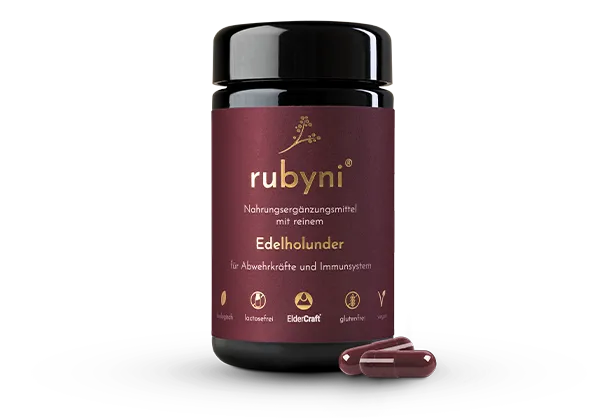
The Boost for Your Immune System
rubyni® elderberry
- rubyni® Elderberry contributes to the normal function of your immune system
- Each capsule contains 400 mg of elderberry extract
- Organic, vegan, lactose- and gluten-free
- Proven through studies