
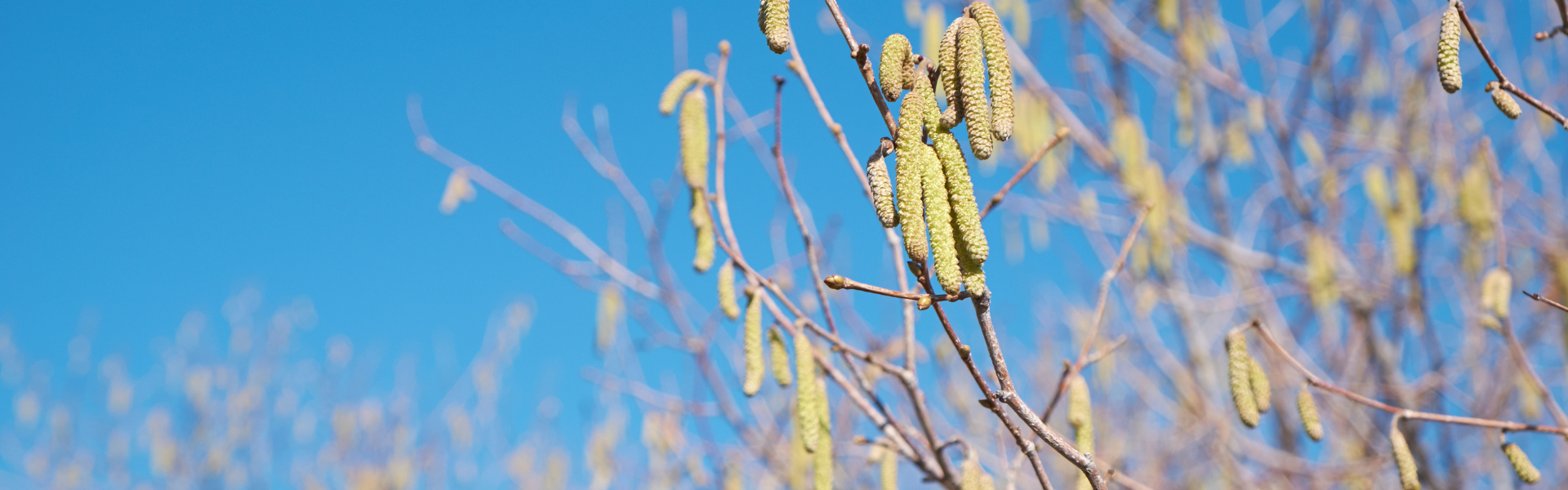
Are you one of those people who are plagued by hay fever? If so, you’re in good company, as around one in four adults in Germany are.1 The first pollen is already flying through the air and it feels like the peak season starts earlier every year. Read on to find out what happens in the body with a pollen allergy, what the immune system has to do with it and how you can arm yourself.
Blackcurrant: plant power with a long tradition
Before we continue talking about hay fever, we would like to introduce you to blackcurrants: The deep black berries are full of valuable ingredients such as anthocyanins and vitamin C, which can protect the cells and strengthen the immune system. 2, 3 This has been known for centuries in the herbalism of Traditional European Medicine (TEM).
This knowledge was passed on by experienced experts in the field, including Hildegard von Bingen (1098 – 1179).4 Blackcurrant still has a firm place in naturopathy today. Preparations made from the berries and other parts of the plant are used, for example, as a mouth spray or capsules for various ailments. These include sore throats, coughs – and even hay fever.5
Pollen allergy: Why does the body react so strongly?
Hay fever is a pollen allergy, i.e. an allergic reaction to pollen (pollen flying around). In those affected, pollen acts as an allergen, i.e. an allergy-triggering substance. If allergy sufferers inhale pollen, their immune system mistakenly perceives it as a pathogen and responds with an overreaction. Various messenger substances are released that put the body on alert, for example histamine.6 This leads to symptoms such as a runny nose, watery eyes and itching.7
Various medications are available to treat these symptoms in the form of tablets, eye drops or nasal sprays, for example antihistamines. Although they cannot cure the allergy, they can at least alleviate the symptoms. They do this by slowing down the effect of histamine.8
Pollen count: is the season starting earlier and earlier?
The main triggers of hay fever are pollen from trees such as birch and hazel, grasses and herbs such as mugwort. 6 In Central Europe, the typical pollen count takes place in spring, with seasonal peaks in April and July. However, some plant species, known as early bloomers, start flowering in January or as early as December, while others flower in the fall and into November.
Climate change is contributing to an extension of the pollen season with higher temperatures and more drought. This means that some allergy sufferers experience symptoms almost all year round.9 If you want to know more precisely which pollen is swirling through the air, when and where, a pollen count calendar can help. There are several online, and the pollen forecast on the website of the German Weather Service is also helpful.10
Hyposensitization: getting the immune system used to the allergen
Specific immunotherapy, also known as hyposensitization, directly addresses the cause of the allergy: the immune system. The aim is to get the immune system used to the allergen. The aim is to prevent an overreaction. For this purpose, tiny, gradually increasing amounts of the allergen are administered over a certain period of time in the form of tablets, drops or injections. Contact with the allergen is “practiced” more and more until gradually fewer or no symptoms are triggered. The treatment usually lasts three years.11
Which micronutrients can support the immune system?
What can you do to protect yourself from allergies? One way is to lead a healthy lifestyle that also strengthens the immune system. A well-functioning immune system is less susceptible to allergies. It is better able to distinguish between harmless pollen and real dangers and is therefore less prone to allergic overreactions.12, 13
A balanced diet with plenty of fruit and vegetables provides you with vitamins, minerals and secondary plant substances as well as fiber. In this way, you strengthen your immune system with the power of plants. Particularly important for a functioning immune system: the micronutrient vitamin C.14 It has an antioxidant effect, i.e. it intercepts harmful compounds such as free radicals and thus protects the body’s cells from damage caused by oxidative stress. Oxidative stress can exacerbate allergic rhinitis, including hay fever.15, 16
This is where we encounter blackcurrants again: these little powerhouses contain a particularly large number of secondary plant substances, such as the anthocyanins mentioned above. These are plant pigments that give red to deep black fruits their color. Among other things, they protect the plant from excessive UV radiation. When we humans consume these secondary plant substances, they can protect our cells by rendering free radicals harmless.17
Probiotics and prebiotics for a healthy gut
The effectiveness of your immune system is strongly influenced by the health of your gut. This is where most of the immune cells are located.18 In turn, gut health depends on the gut flora – the composition of the microorganisms that colonize the gut.19 “Good” bacteria contribute to a balance in the gut flora. They are contained as so-called probiotics in fermented foods such as yoghurt, kefir, sauerkraut and kimchi.20
But it’s not just about getting these good bacteria into our gut. We need to “feed” them so that they can multiply diligently and keep the “bad” bacteria in check. This is achieved with a diet rich in certain dietary fibers such as polysaccharides. These largely indigestible food components have a so-called prebiotic effect. This means that they serve as food for the beneficial bacteria in the intestine and thus indirectly support intestinal health. If you want to eat a high-fiber diet, eat plenty of vegetables, pulses, wholegrain products, nuts and berries. This will provide the good bacteria with plenty of food and contribute to healthy digestion.21, 22
FAQs – Frequently asked questions
Why should you strengthen your immune system if you have a pollen allergy?
The immune system of hay fever allergy sufferers mistakenly perceives pollen as a pathogen and responds with an overreaction, which triggers the typical symptoms. A well-functioning immune system is less susceptible to allergies and is better able to distinguish between harmless and dangerous substances.6, 12, 13
What are important micronutrients for the immune system in the case of hay fever?
To ensure that the immune system functions well, make sure you eat a balanced diet that provides you with sufficient vital nutrients. Vitamin C is particularly important for the immune system as it has an antioxidant effect and thus protects the body’s cells from damage caused by oxidative stress. This can exacerbate hay fever.14, 15, 16 Anthocyanins are also antioxidants. These natural colorants are found in blackcurrants, for example.
Why are probiotics so important for the immune system?
The immune system is also influenced by intestinal health. Probiotics are living microorganisms that can have a positive effect on the balance of the intestinal flora if they are ingested in sufficient quantities. These “good” bacteria influence not only digestion but also the immune system. They are contained in yoghurt, kefir and sauerkraut, for example.23
Quellen
- Deutscher Allergie- und Asthmabund. Mythen und Irrtümer zum Heuschnupfen. https://www.daab.de/2025/03/mythen-und-irrtuemer-zum-heuschnupfen#:~:text=%E2%80%9EEin%20Heuschnupfen%20ist%20harmlos%2C%20wer,fr%C3%BChzeitig%20und%20richtig%20behandelt%20werden., letzter Abruf am 28.01.2026
- DocMedicus. Anthocyane – Funktionen. https://www.vitalstoff-lexikon.de/Sekundaere-Pflanzenstoffe/Anthocyane/Funktionen, letzter Abruf am 28.01.2026
- DocMedicus. Ernährung und Nahrungsergänzung für das Immunsystem. https://www.gesundheits-lexikon.com/Blutbildende-Organe-Immunsystem/Ernaehrung-und-Nahrungsergaenzung/Ernaehrung-und-Nahrungsergaenzung-fuer-das-Immunsystem, letzter Abruf am 28.01.2026
- ORF für alle. Gesundheit. Schwarze Ribisel bei Allergien. https://noe.orf.at/magazin/stories/3203662/, letzter Abruf am 28.01.2026
- PharmaWiki. Schwarze Johannisbeere. https://www.pharmawiki.ch/wiki/index.php?wiki=schwarze%20Johannisbeere, letzter Abruf am 28.01.2026
- Helmholtz Zentrum München. Allergieinformationsdienst. Heuschnupfen – Was ist das? https://www.allergieinformationsdienst.de/krankheitsbilder/heuschnupfen/grundlagen, letzter Abruf am 28.01.2026
- Helmholtz Zentrum München. Heuschnupfen: Symptome. https://www.allergieinformationsdienst.de/krankheitsbilder/heuschnupfen/symptome, letzter Abruf am 28.01.2026
- Helmholtz Zentrum München. Antihistaminika. https://www.allergieinformationsdienst.de/therapie/allergie-medikamente/antihistaminika, letzter Abruf am 28.01.2026
- Umweltbundesamt. GE-I-3: Belastung mit Birkenpollen. https://www.umweltbundesamt.de/monitoring-zur-das/handlungsfelder/gesundheit/ge-i-3/indikator#pollenbelastung-steigt-, letzter Abruf am 28.01.2026
- Deutscher Wetterdienst. Pollenflug-Gefahrenindex. https://www.dwd.de/DE/leistungen/gefahrenindizespollen/gefahrenindexpollen.html, letzter Abruf am 28.01.2026
- Helmholtz Zentrum München. Allergieinformationsdienst. Spezifische Immuntherapie (Hyposensibilisierung) https://www.allergieinformationsdienst.de/therapie/spezifische-immuntherapie-hyposensibilisierung, letzter Abruf am 28.01.2026
- Lungenärzte im Netz. Allergien, allgemein. Vorbeugung. https://www.lungenaerzte-im-netz.de/krankheiten/allergien-allgemein/vorbeugung/, letzter Abruf am 28.01.2026
- Universitätsambulanz für Integrative Gesundheitsversorgung und Naturheilkunde. Witten. Heuschnupfen. https://www.uniambulanz-witten.de/heuschnupfen-wie-umgehen-mit-der-pollenallergie/, letzter Abruf am 28.01.2026
- Deutsche Gesellschaft für Ernährung (DGE). Hilft Vitamin C gegen Erkältungen? https://www.dge.de/presse/meldungen/2011-2018/hilft-vitamin-c-gegen-erkaeltungen/#:~:text=F%C3%BCr%20Erwachsene%20betr%C3%A4gt%20diese%20110,Gem%C3%BCse%20nur%20kurz%20ged%C3%BCnstet%20werden., letzter Abruf am 28.01.2026
- ÄrzteZeitung. Allergien und Entzündungen. Welchen Nutzen Vitamin C bei Allergien haben kann https://www.aerztezeitung.de/Wirtschaft/Welchen-Nutzen-Vitamin-C-bei-Allergien-haben-kann--456183.html, letzter Abruf am 28.01.2026
- Bowler RP, Crapo JD. Oxidative stress in allergic respiratory diseases. J Allergy Clin Immunol. 2002 Sep;110(3):349-56. https://pubmed.ncbi.nlm.nih.gov/12209079/, letzter Abruf am 28.01.2026
- DocCheck Flexikon. Anthocyan. https://flexikon.doccheck.com/de/Anthocyan, letzter Abruf am 28.01.2026
- Universitätsklinikum Erlangen. Der Darm - Ein Organ mit vielen Superlativen. https://www.medizin1.uk-erlangen.de/forschung/arbeitsgruppen/ag-prof-c-becker/thema-darm/#:~:text=Der%20Darm%20ist%20das%20gr%C3%B6%C3%9Fte,ein%20zentrales%20Thema%20unserer%20Arbeitsgruppe., letzter Abruf am 28.01.2026
- DocCheck Flexikon. Mikrobiom. https://flexikon.doccheck.com/de/Mikrobiom, letzter Abruf am 28.01.2026
- DocCheck Flexikon. Probiotikum. https://flexikon.doccheck.com/de/Probiotikum, letzter Abruf am 28.01.2026
- DocCheck Flexikon. Präbiotikum. https://flexikon.doccheck.com/de/Pr%C3%A4biotikum, letzter Abruf am 28.01.2026
- Deutsche Gesellschaft für Ernährung (DGE). Ausgewählte Fragen und Antworten zu Ballaststoffen. https://www.dge.de/gesunde-ernaehrung/faq/ausgewaehlte-fragen-und-antworten-zu-ballaststoffen/, letzter Abruf am 28.01.2026
- DocMedicus. Probiotika – Warum gute Bakterien so wichtig sind. https://www.gesundheits-lexikon.com/Ernaehrung-Diaeten/Probiotika-Probiotische-Lebensmittel/Probiotika-warum-gute-Bakterien-so-wichtig-sind, letzter Abruf am 28.01.2026
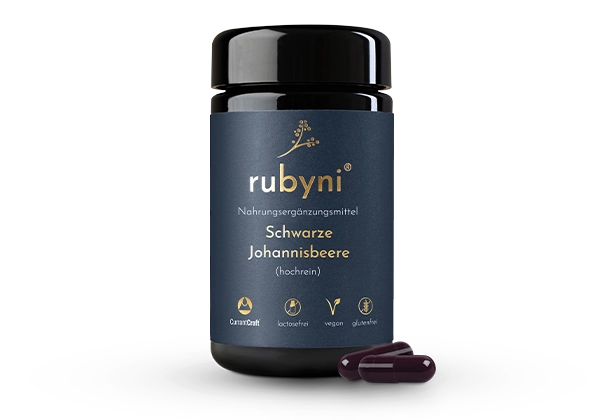
Plant power with tradition
rubyni® Blackcurrant
- Blackcurrant extract from the blackcurrant variety ‘Blackdown’ One capsule contains 445mg blackcurrant extract, of which 48.9mg anthocyanins
- Without preservatives and fillers
- vegan, lactose- and gluten-free