
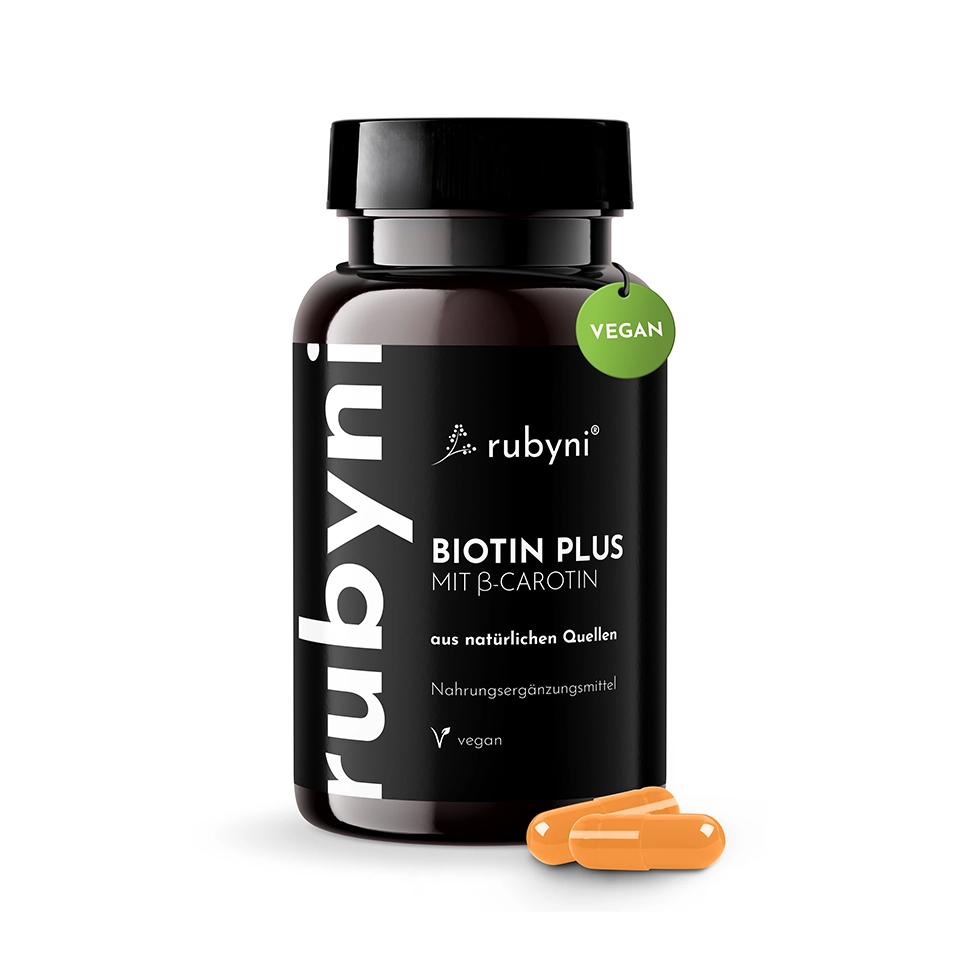
rubyni BIOTIN PLUS
Biotin: an important building block for your hair, skin and mucous membranes*
rubyni BIOTIN PLUS
60 capsules 59,90€
Incl. VAT, plus shippingFood supplement with biotin and beta-carotene from natural sources
100% vegan, gluten- and lactose-free
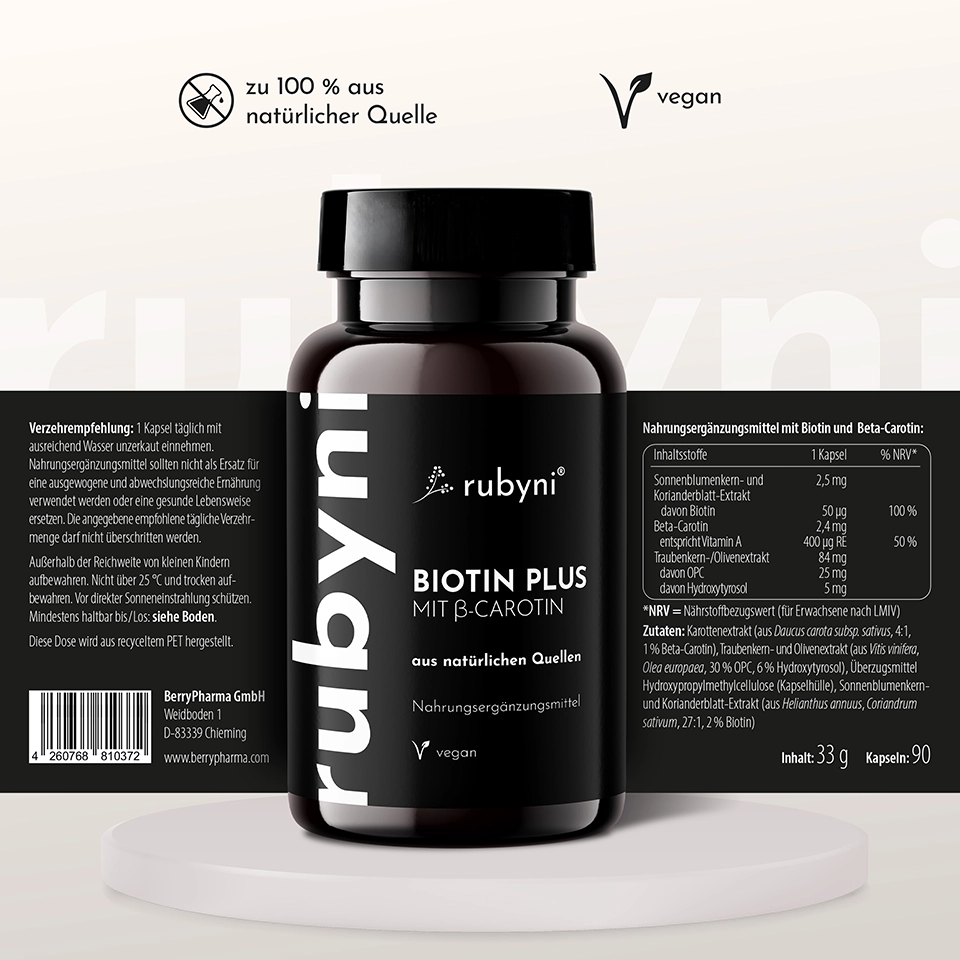
Ingredients: Carrot extract (from Daucus carota subsp. sativus 4:1, 1 % beta-carotene), grape seed and olive extract (from Vitis vinifera, Olea europaea, 30 % OPC, 6 % hydroxytyrosol), coating agent hydroxypropyl methylcellulose (vegetable capsule shell), sunflower seed and coriander leaf extract (from Helianthus annuus, Coriandrum sativum, 27:1, 2 % biotin)
Recommended intake: Take 1 capsule daily unchewed with plenty of water. To ensure that the fat-soluble beta-carotene can be optimally absorbed by your body, your meal should also contain healthy fats. Do not exceed the recommended daily intake.
What do skin, hair and mucous membranes have in common? Quite simply: if they are healthy, this can make an important contribution to your well-being. To do this, they need sufficient amounts of certain micronutrients. These include biotin (vitamin B7) and vitamin A.
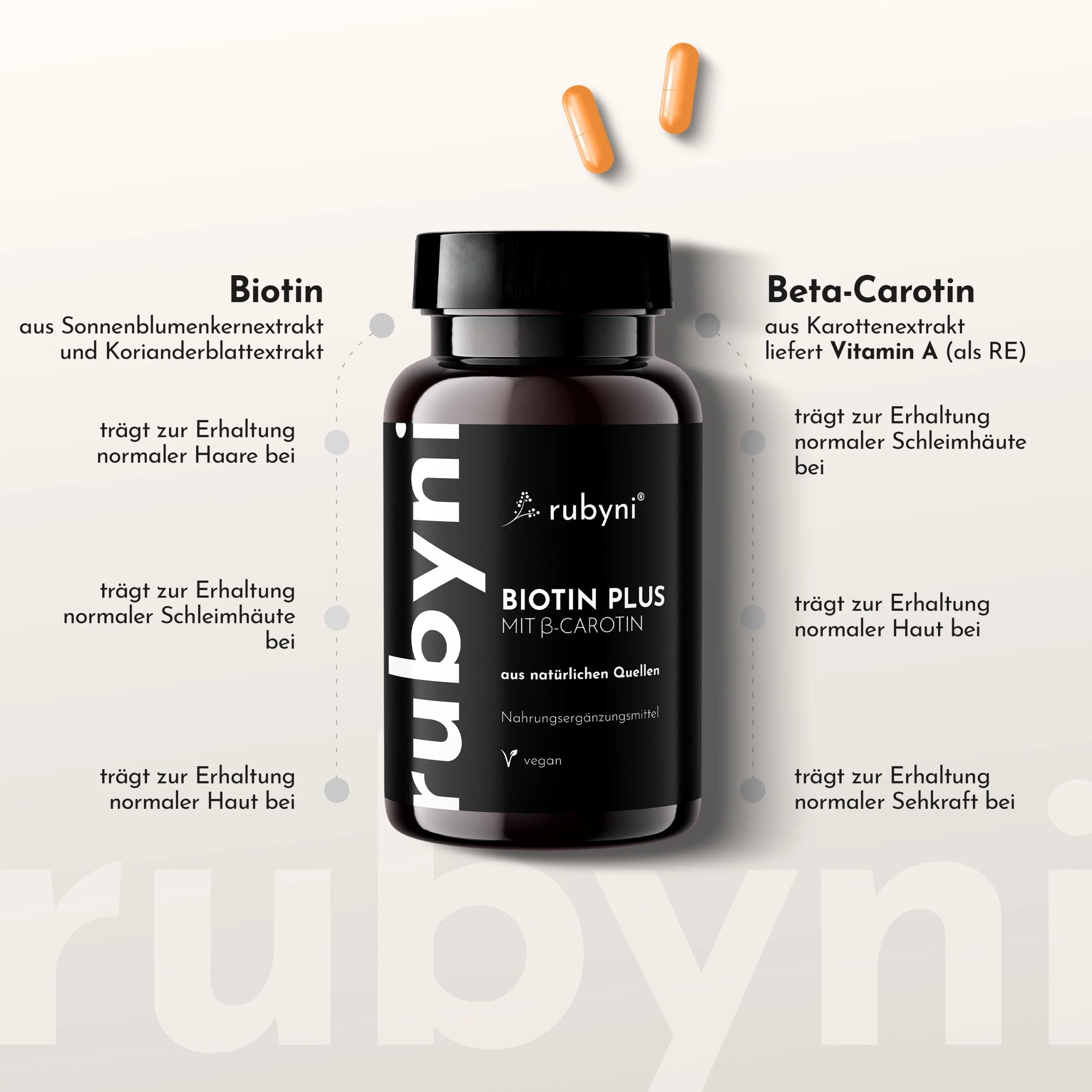
Biotin contributes to the maintenance of normal hair, normal skin and normal mucous membranes. 1,2,3,4,5,6,7,8,9 Vitamin A also contributes to the maintenance of normal skin and normal mucous membranes – and also to the maintenance of normal vision 1, 8, 9
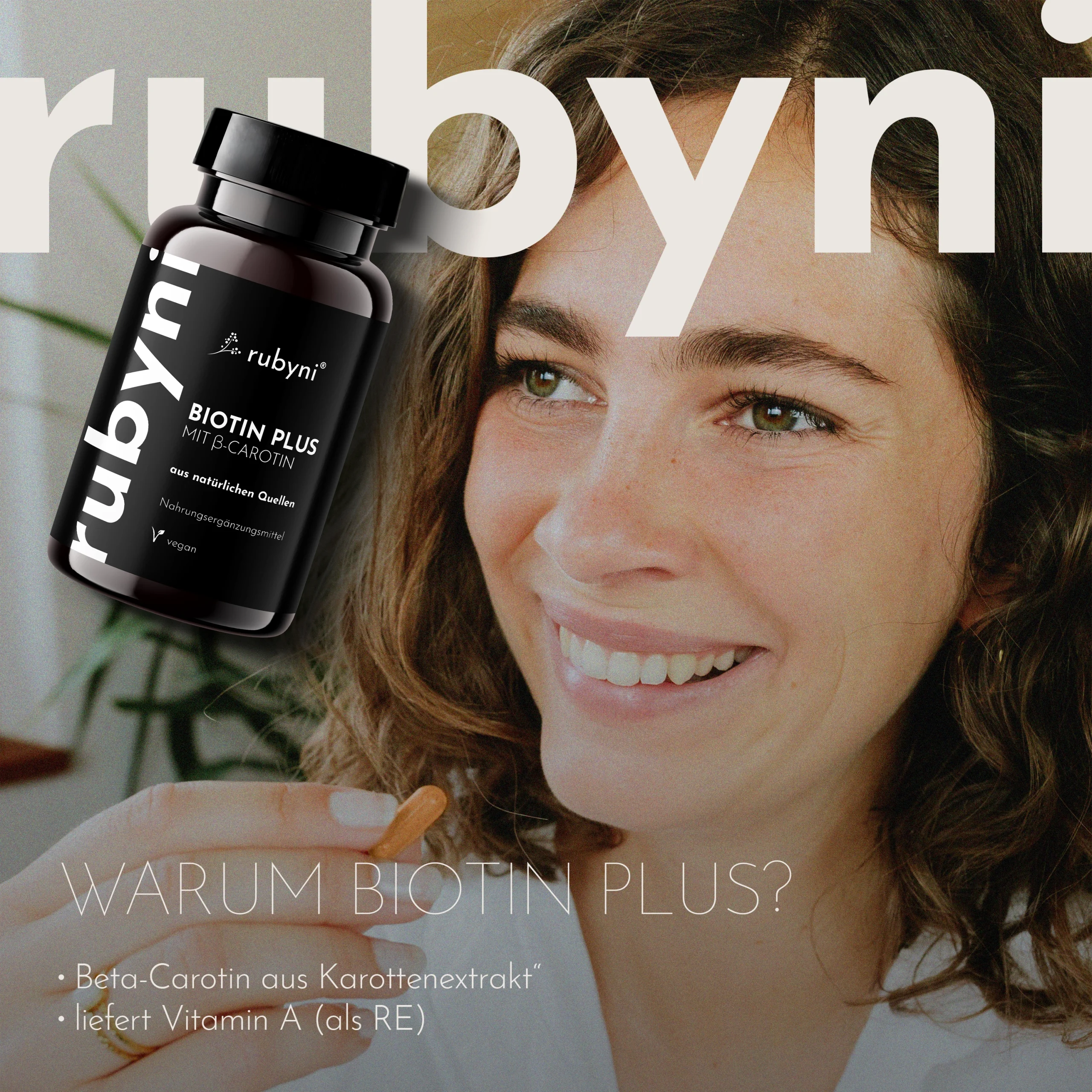
rubyni BIOTIN PLUS provides you with biotin from a vegan source. The capsules also contain beta-carotene, a natural precursor of vitamin A.
rubyni BIOTIN PLUS
Biotin and beta-carotene from a natural source
- Contains biotin (vitamin B7) from organic sunflower seed and coriander leaf extract
- Contains beta-carotene from high-quality carrot extract. Beta-carotene is a precursor of vitamin A
- Supplies two additional polyphenols: OPC (oligomeric proanthocyanidins) from grape seed and hydroxytyrosol from olive extracts
- Vegan, lactose- and gluten-free

How much biotin does your body need?
Your body cells cannot produce biotin (vitamin B7) themselves, and there is no storage form for the water-soluble vitamin. You must therefore take it in regularly through your diet. The German Nutrition Society (DGE) 7 recommends the following for
- Adults and pregnant women 40 micrograms (µg) of biotin daily,
- breastfeeding women 45 µg per day.
The European Union (EU) specifies 50 µg of biotin per day as the so-called nutrient reference value (NRV for short). 10 In the manufacture of food supplements, the NRV serves as a guide for the dosage of vitamins and minerals.
However, there are situations in which your requirement may be increased. Then a supplementary supply of biotin via food supplements can be useful.
How much vitamin A do you need?
The term vitamin A covers several fat-soluble vitamins that are only found in animal foods such as liver (sausage), fish (cod liver oil), eggs and dairy products (cheese). The main form is retinol. 8, 9
In contrast, carotenoids – including the important beta-carotene (β-carotene) – come from plants. They serve your body as a vitamin A precursor (provitamin A). This means that it can convert the carotene into vitamin A. 8, 9
The conversion rates of the various precursors into the active vitamin differ and are stated as retinol activity equivalents (RAE) or retinol equivalents (RE). The following applies:
1 µg RAE = 12 µg beta-carotene
1 µg RE = 6 µg beta-carotene
The DGE recommends
- Women 700 μg vitamin A or μg RAE per day,
- Pregnant women and men aged 65 and over 800 μg RAE daily,
- Men aged 19 to 64 years 850 μg RAE per day.
The NRV specified by the EU is 800 μg vitamin A (or RAE) – the same for both sexes. 10
Optimally supplied with rubyni BIOTIN PLUS
Just one capsule of rubyni BIOTIN PLUS provides you with 50 micrograms of the important biotin (vitamin B7) – that is 100 % of the daily requirement according to NRV*.
Our product also contains 2.4 milligrams of beta-carotene and can therefore make an additional contribution to a balanced diet. This corresponds to 400 μg RE and therefore 50% of the daily requirement according to NRV*.
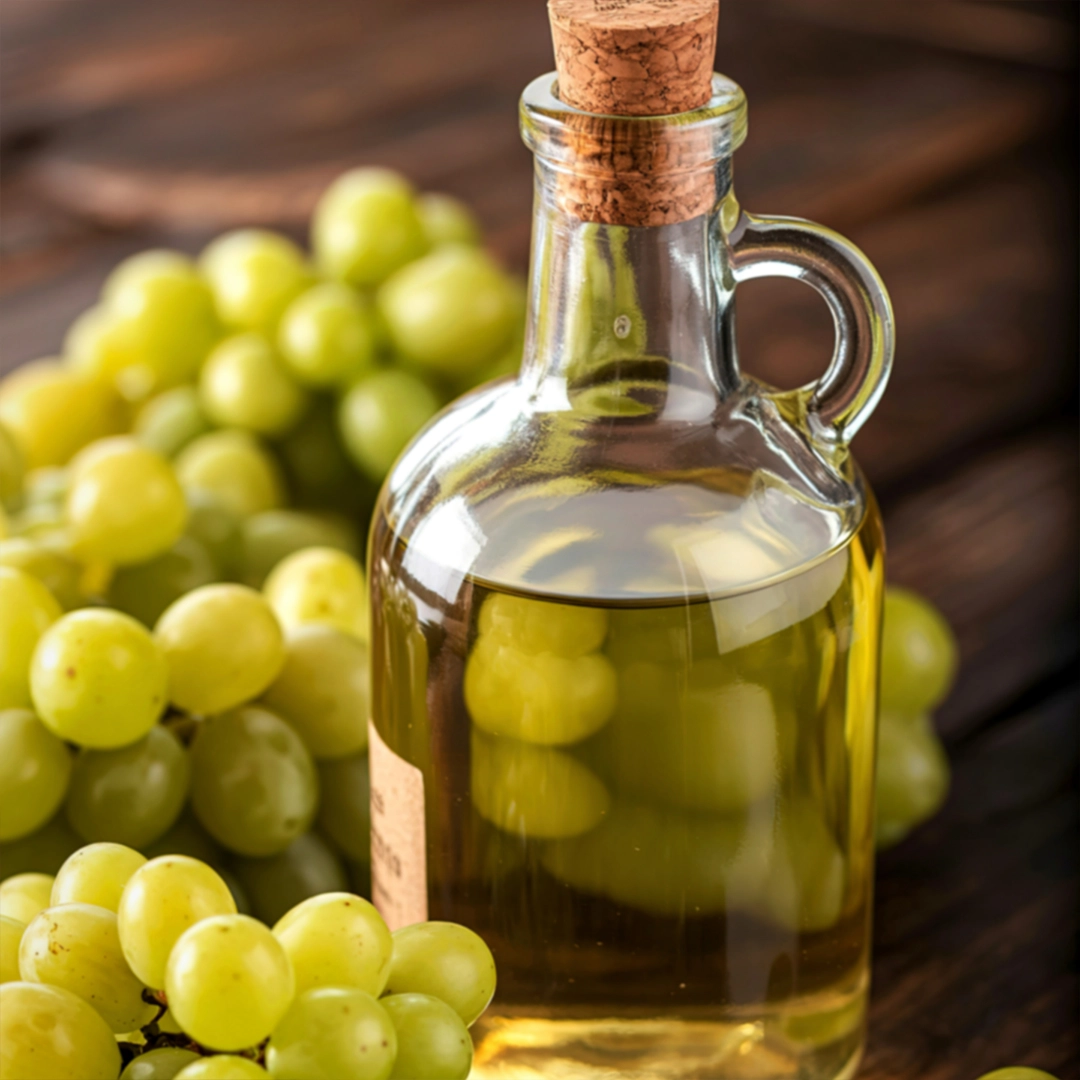
In addition, one capsule of rubyni BIOTIN PLUS provides you with 84 mg of grape seed olive extract, which is characterized by two valuable secondary plant substances (polyphenols): 25 mg OPC (oligomeric proanthocyanidins) and 5 mg hydroxytyrosol.
Note: Food supplements should not be used as a substitute for a balanced and varied diet or to replace a healthy lifestyle.
*NRV = nutrient reference value (for adults according to the Food Information Regulation (LMIV))
rubyni BIOTIN PLUS: What’s in our capsules
rubyni BIOTIN PLUS is a dietary supplement based on natural plant extracts:
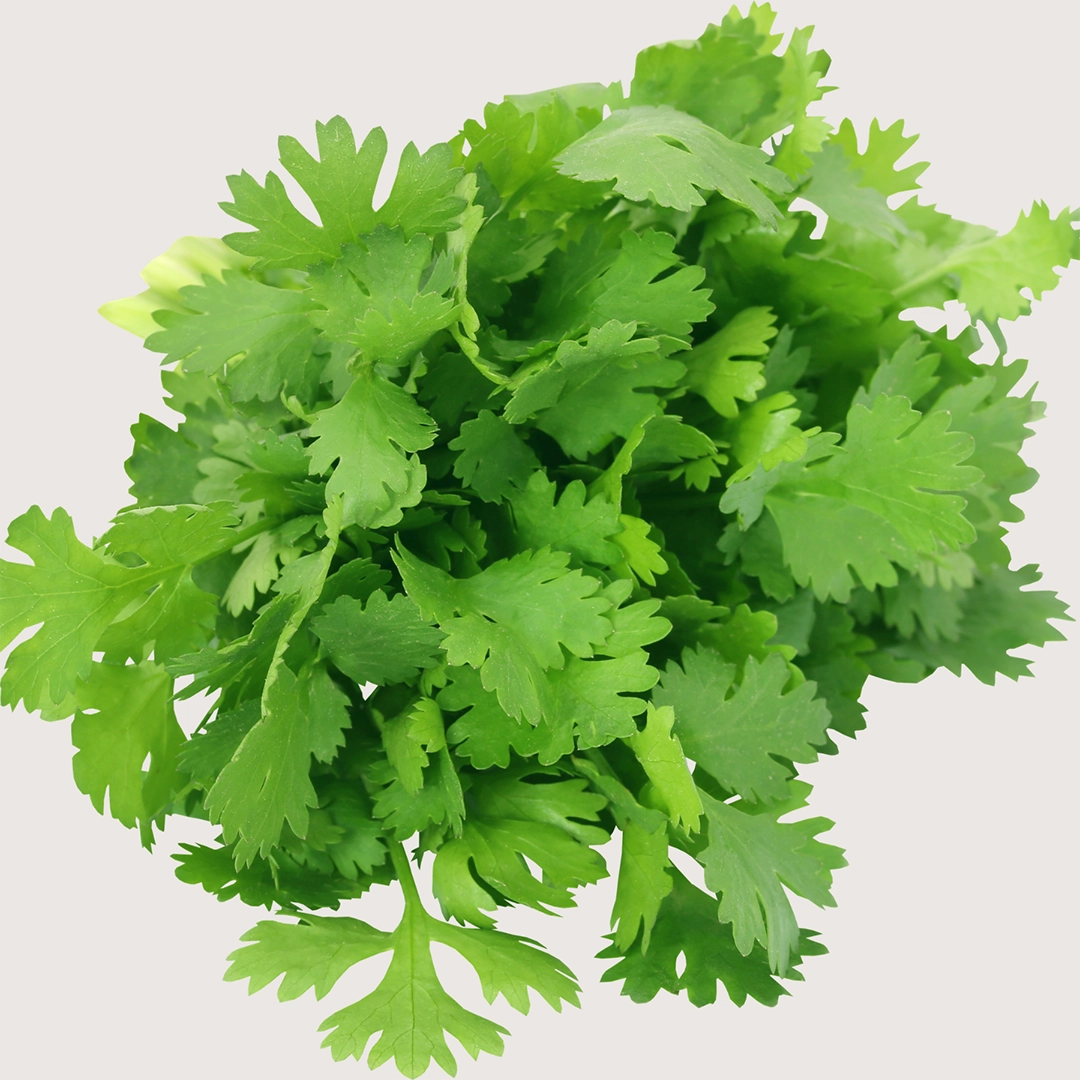
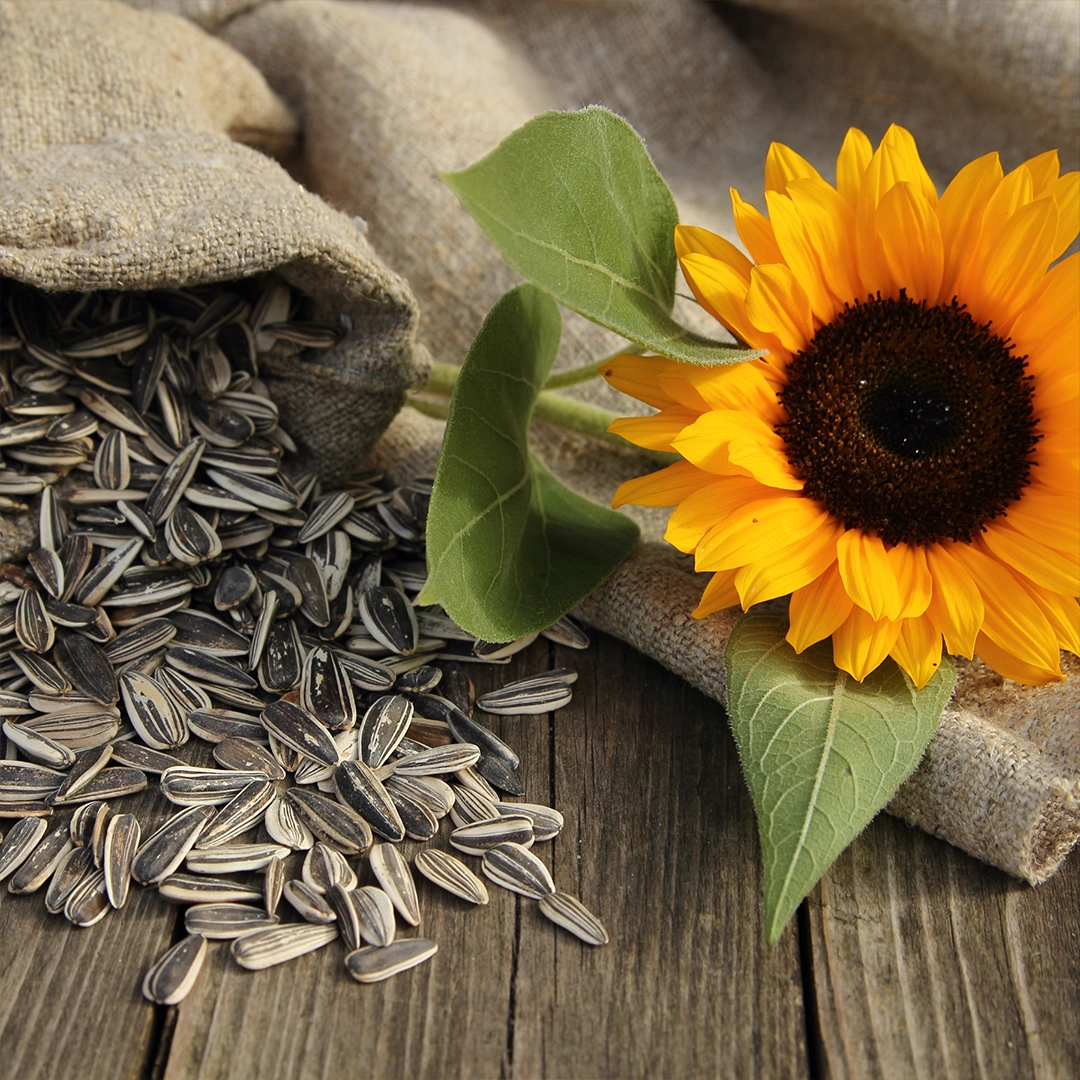
- We obtain the biotin (vitamin B7) it contains from a certified organic extract of sunflower seeds(Helianthus annuus) and coriander leaves(Coriandrum sativum). The high-quality raw materials from India are gently processed using lemon juice and coconut vinegar in water – completely natural ingredients – as solvents.
- The biotin is combined with beta-carotene, a natural carotenoid that gives carrots their typical color. It is the natural precursor of vitamin A. For our product we use a carefully obtained extract of high-quality vegetable carrots ( Daucus carota subsp. sativus ), which is free from fruit sugar (fructose).
- rubyni BIOTIN PLUS is rounded off with pure grape seed(Vitis vinifera) and olive(Olea europaea) extracts, which do not require any carriers. They provide two secondary plant substances from the polyphenol family: OPC (oligomeric proanthocyanidins) and hydroxytyrosol. The raw materials come from France and are standardized for their polyphenol content.

Good to know:
Biotin – not just for skin and hair
An old name for biotin (vitamin B7) is vitamin H – “H” as in hair and skin. 12 Biotin contributes to the maintenance of normal hair and normal skin – as well as to the maintenance of normal mucous membranes.
However, the vitamin also fulfills many other tasks in your body. For example, biotin contributes to a normal energy metabolism, as well as to a normal metabolism of macronutrients. These are carbohydrates (sugar), proteins (amino acids) and fat (acids). Biotin is also involved in the normal function of the nervous system and normal mental function. 13
Which foods contain biotin?
Many foods contain biotin, but often only in small amounts. Dried yeast provides plenty of vitamin B7, but is only consumed in small quantities. Liver – a good source of biotin – is also rarely or not at all on the menu for many people. Boiled class M eggs weighing around 50 grams provide you with around 12 µg of biotin. Legumes such as soybeans and lentils, wholegrain products and unhulled rice as well as oat flakes 3, 12, 15 can also contribute to the supply of biotin.
A healthy and varied diet usually helps you to cover your needs. However, in the hustle and bustle of everyday life, sufficient supply sometimes suffers. In addition, certain factors can make the absorption of biotin in the intestine more difficult or accelerate the breakdown of the vitamin. The groups in which the requirement may be increased include 16:
- People in whom the absorption of biotin from the intestine is reduced 17
- People who take antibiotics over the long term
- Pregnant women
- People who smoke or regularly consume alcohol 4

Beta-carotene and vitamin A: what’s the difference?
Vitamin A is essential for your body as it fulfills various tasks. Beta-carotene, also known as provitamin A, is a natural precursor of vitamin A. While vitamin A (retinol) is only found in animal foods, beta-carotene is found in plants: In addition to carrots, apricots, green leafy vegetables, pumpkin and peppers also provide the vitamin precursor. 11
If there is an oversupply of vitamin A, the fat-soluble vitamin can accumulate in the liver. 9 Your body only converts provitamin A into the active vitamin when needed 18.
What role does vitamin A play in your health?
Like biotin, vitamin A contributes to the maintenance of normal skin and mucous membranes. 1, 8, 9
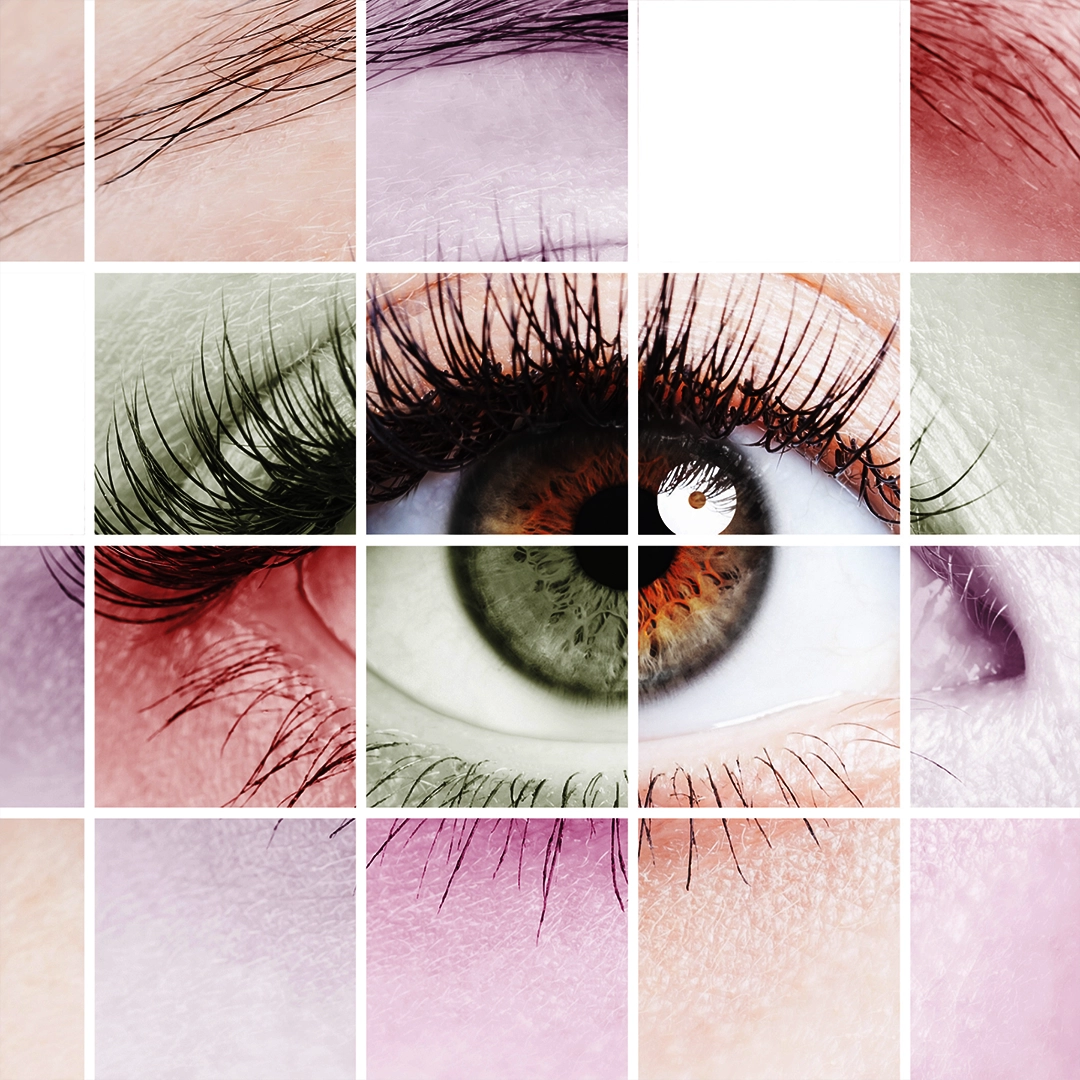
Vitamin A is also involved in maintaining normal vision 1, 8, 9: In the form of retinal, the vitamin is a component of the so-called visual purple and thus of the visual process. This light-sensitive pigment is found in high concentrations in the rods, the elongated light-sensing cells in the retina of the eye. It can distinguish between light and dark. 8, 19
What are the health benefits of biotin and vitamin A?
Biotin (vitamin B7) supports a variety of functions in your body. 1, 2,13
Biotin
- contributes to the maintenance of normal hair
- contributes to the maintenance of normal skin
- contributes to the maintenance of normal mucous membranes
- contributes to the normal metabolism of macronutrients
- contributes to normal energy metabolism
- contributes to the normal function of the nervous system
- Contributes to normal mental function
Beta-carotene (provitamin A) is a precursor of vitamin A. 1, 9
Vitamin A 8, 9, 11
- contributes to the maintenance of normal skin
- contributes to the maintenance of normal mucous membranes
- contributes to the maintenance of normal vision
- contributes to a normal iron metabolism b
- contributes to the normal function of the immune system
- has a function in cell specialization
Frequently asked questions /FAQs
1. what makes rubyni BIOTIN PLUS so special?
rubyni BIOTIN PLUS consists of several high-quality plant extracts: Sunflower seeds and coriander leaves provide you with a large portion of natural biotin (vitamin B7), carrots provide natural beta-carotene (provitamin A), a vitamin A precursor. They also contain valuable polyphenols: OPC (oligomeric proanthocyanidins) from grape seeds and hydroxytyrosol from olives.
2. how does rubyni BIOTIN PLUS support your hair, skin and mucous membranes?
The product contains biotin (vitamin B7), which contributes to the maintenance of normal skin, normal hair and normal mucous membranes. It also contains natural beta-carotene, a precursor of vitamin A. This vitamin is also involved in the maintenance of normal skin and normal mucous membranes.
3. how many capsules of rubyni BIOTIN PLUS should I take daily?
The recommended daily intake for healthy adults is one capsule of rubyni BIOTIN PLUS – with sufficient water and without chewing. For optimum absorption of the fat-soluble beta-carotene, the meal should also contain healthy fats. With one capsule you take 50 µg biotin, which corresponds to 100 % of the daily requirement according to NRV*, and 2.4 mg beta-carotene, which corresponds to 50 % of the daily requirement according to NRV*.
*Nutrient reference value (for adults according to the Food Information Regulation (FIR))
4. is rubyni BIOTIN PLUS vegan, lactose-free and gluten-free?
Yes, rubyni BIOTIN PLUS consists of 100 % vegan ingredients in a plant-based capsule shell (made from hydroxypropyl methylcellulose). The biotin comes from a certified organic extract of sunflower seeds(Helianthus annuus) and coriander leaves(Coriandrum sativum), the beta-carotene (provitamin A) from a carrot extract. It also contains two polyphenols: OPC (oligomeric proanthocyanidins) and hydroxytyrosol, which are obtained from grape seed and olive extracts. All ingredients are lactose- and gluten-free.
References:
1 Verordnung (EU) Nr. 432/2012 der Kommission vom 16. Mai 2012 https://eur-lex.europa.eu/legal-content/DE/TXT/PDF/?uri=CELEX:02012R0432-20250820, zuletzt abgerufen am 23.03.2026
2 EFSA NDA Panel. Scientific Opinion on biotin. EFSA Journal 2010; 8(10): 1728. [ID 114, 117, 113, 114, 117, 115, 118, 2876, 116]. https://efsa.onlinelibrary.wiley.com/doi/epdf/10.2903/j.efsa.2009.1209, zuletzt abgerufen am 23.03.2026
3 Patel DP et al. A Review of the Use of Biotin for Hair Loss. https://pmc.ncbi.nlm.nih.gov/articles/PMC5582478/
4 Trüb RM. Serum Biotin Levels in Women Complaining of Hair Loss. https://pmc.ncbi.nlm.nih.gov/articles/PMC4989391/
5 Reinke C. Biotin (Vitamin H) – Wichtig für die Gesundheit von Haaren und Nägeln. Ernährungsmedizin 03/2004. https://www.rosenfluh.ch/media/ernaehrungsmedizin/2004/03/Biotin-Vitamin-H.pdf, zuletzt abgerufen am 23.03.2026
6 Cleveland Clink. Is Biotin as Good as Advertised for Your Hair Loss? Stand: 26.10.2022. https://health.clevelandclinic.org/is-biotin-as-good-as-advertised-for-your-hair-loss, zuletzt abgerufen am 23.03.2026
7 Deutsche Gesellschaft für Ernährung (DGE). Referenzwerte: Biotin. Stand: 2020. https://www.dge.de/wissenschaft/referenzwerte/biotin/, zuletzt abgerufen am 23.03.2026
8 EFSA NDA Panel. Scientific Opinion on vitamin A. EFSA Journal 2009; 7(9): 1221. [ID 14, 14, 15, 17, 16, 13, 17, 13, 17, 17, 17, 206, 209]. https://efsa.onlinelibrary.wiley.com/doi/pdf/10.2903/j.efsa.2009.1221, zuletzt abgerufen am 23.03.2026
9 Deutsche Gesellschaft für Ernährung (DGE). Ausgewählte Fragen und Antworten zu Vitamin A. Stand: 10.09.2025. https://www.dge.de/gesunde-ernaehrung/faq/ausgewaehlte-fragen-und-antworten-zu-vitamin-a/, zuletzt abgerufen am 23.03.2026
10 Verordnung (EU) Nr. 1169/2011 des Europäischen Parlamente und des Rates vom 25. Oktober 2011. https://eur-lex.europa.eu/legal-content/DE/TXT/PDF/?uri=CELEX:32011R1169&from=EN , zuletzt abgerufen am 23.03.2026
11 Deutsche Gesellschaft für Ernährung (DGE). Referenzwerte: Vitamin A. Stand: 2020. https://www.dge.de/wissenschaft/referenzwerte/vitamin-a/, zuletzt abgerufen am 23.03.2026
12 VerbraucherFenster Hessen. Biotin – ein Vitamin für Haare und Haut. Stand: 09/2018. https://verbraucherfenster.hessen.de/ernaehrung/vitamine-mineralstoffe/biotin-ein-vitamin-fuer-haare-und-haut
13 Deutsche Gesellschaft für Ernährung (DGE). Ausgewählte Fragen und Antworten zu Biotin. Stand: 10.09.2025. https://www.dge.de/gesunde-ernaehrung/faq/biotin/, zuletzt abgerufen am 23.03.2026
14 VitaminDoctor.com. Biotin: nicht nur ein Schönheitsvitamin. Stand: 27.08.2024. https://www.vitamindoctor.com/naehrstoffe/vitamine/biotin, zuletzt abgerufen am 23.03.2026
15 Deutsches Apotheken Portal (DAP).de. Darmgesundheit und Immunsystem. OTC-Dialog 43. Stand: 2017. https://www.deutschesapothekenportal.de/download/public/dialog/schwerpunktthemen/dap_dialog_43_otc-schwerpunktthema.pdf, zuletzt abgerufen am 23.03.2026
16 https://www.deutsche-apotheker-zeitung.de/news/artikel/2020/09/01/hilft-biotin-bei-haarausfall, zuletzt abgerufen am 23.03.2026
17 Perry CA & TA Butterick. Biotin. Adv Nutr. 2024 May 31; 15 (7): 100251. https://www.sciencedirect.com/science/article/pii/S2161831324000851
18 VitaminDoctor.com. Vitamin A: das Vitamin für Augen und Haut. Stand: 27.08.2024. https://www.vitamindoctor.com/naehrstoffe/vitamine/vitamin-a, zuletzt abgerufen am 23.03.2026
19 DocCheck Flexikon. Rhodopsin. Stand: 25.05.2025. https://flexikon.doccheck.com/de/Rhodopsin, zuletzt abgerufen am 23.03.2026
convinced by rubyni®

Tobias Angerer
Cross-country skier
As a former professional athlete and health-conscious person, my physical performance and well-being are extremely important to me. That's why I take rubyni® with elderberries - it's now part of my daily routine. I am convinced of the positive effects of elderberries on my immune system, my energy levels and my fitness, especially during regeneration after periods of exertion.

Andrea Sokol
Phytotherapist | Nutrition and health consultant
I work as a nutrition and health consultant and am a trained phytotherapist. Transparency, sustainability and quality are very important to me. And I have to say that rubyni® has completely won me over as a brand. The capsules contain only extremely high-quality and natural ingredients whose effectiveness has been proven by studies and which provide the body with important nutrients. I have published several videos about my personal rubyni® journey on my YouTube channel Ohlala & Solala. There I tell you even more about what makes this dietary supplement so special from my point of view.

Hanna Kebinger
Biathlete
As a biathlete, I have to be fit and able to perform at the drop of a hat. I had big problems with that in the past. My body was repeatedly weakened and I had to put up with many setbacks. When I was looking for a solution to support my immune system in the long term, my naturopath introduced me to elderberries as a superfood, among other things. I now take rubyni® with elderberries every day. The capsules are also super handy when I'm on the World Cup circuit. Rubyni® is a valuable aid for me during stressful competition phases and my immune system is finally back on top form.

Prof. Dr. rer. nat. Michaela Döll