
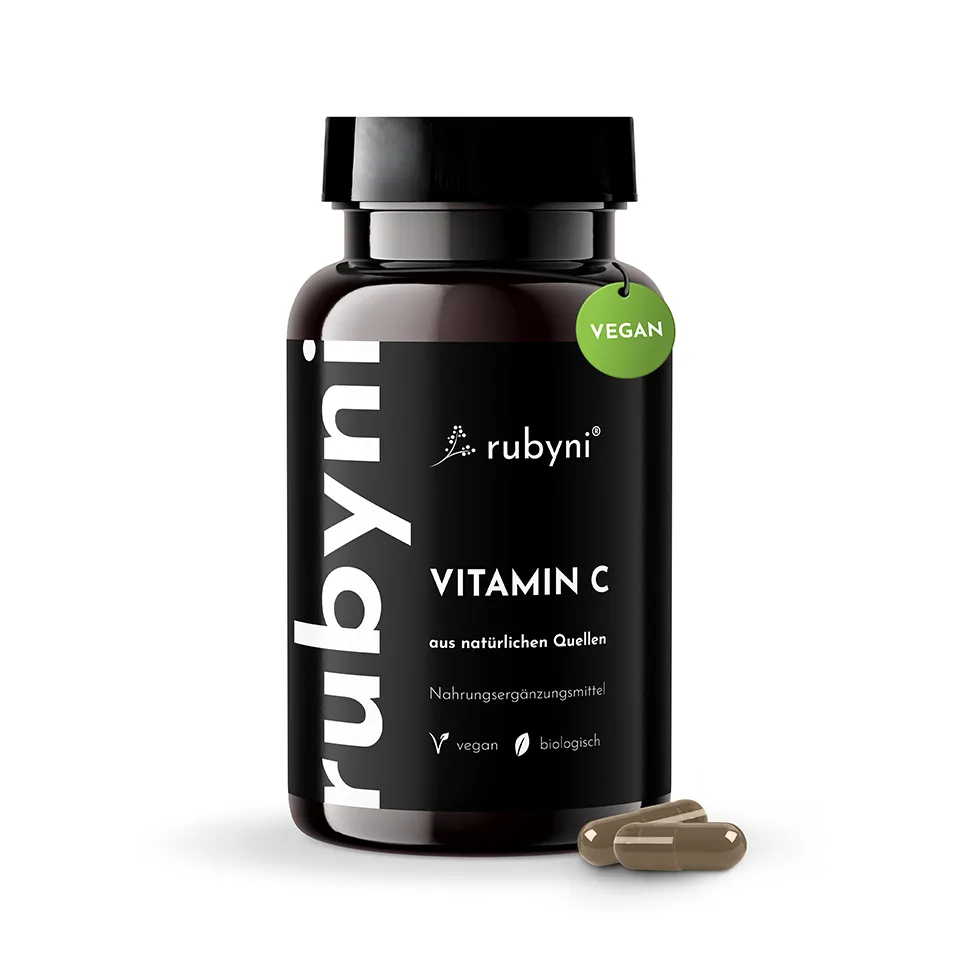
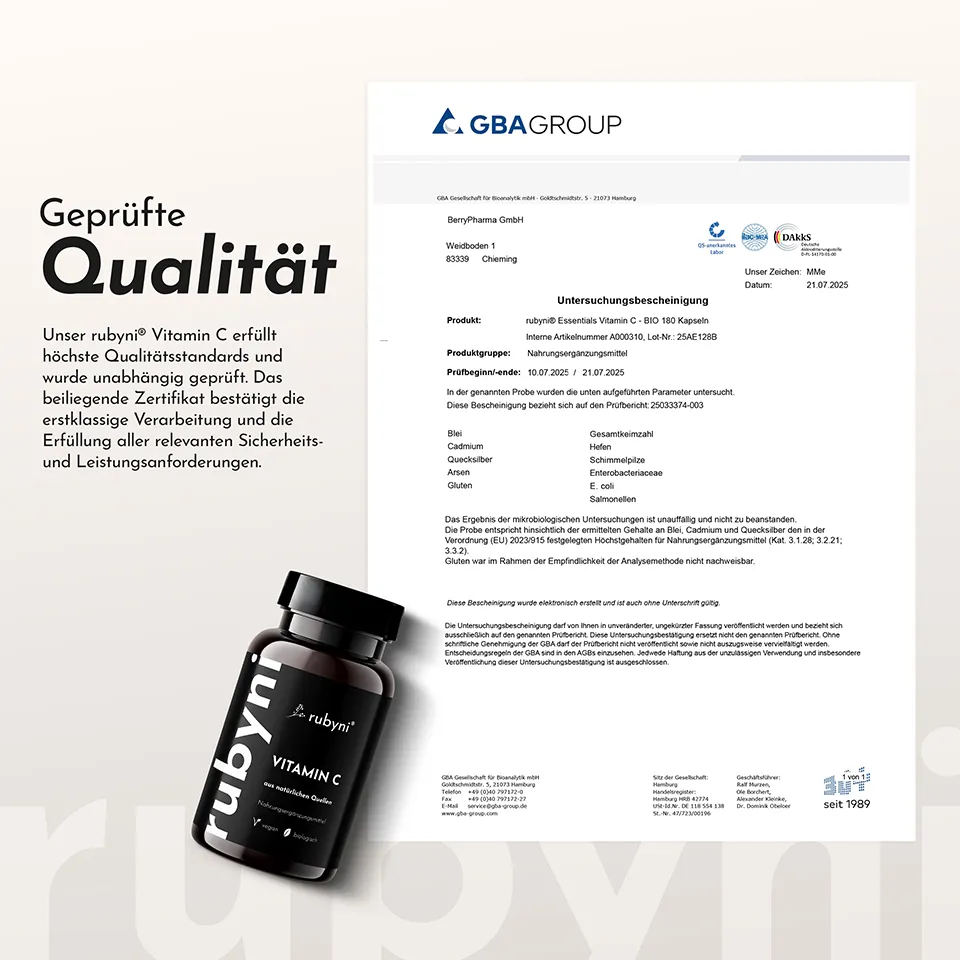
rubyni® Vitamin C
Plant-based vitamin C derived from organic acerola and organic amla
Dietary supplement with vitamin C from organic acerola fruit powder and organic amla fruit extract. 100% vegan, gluten-free, and lactose-free; 100% organic.
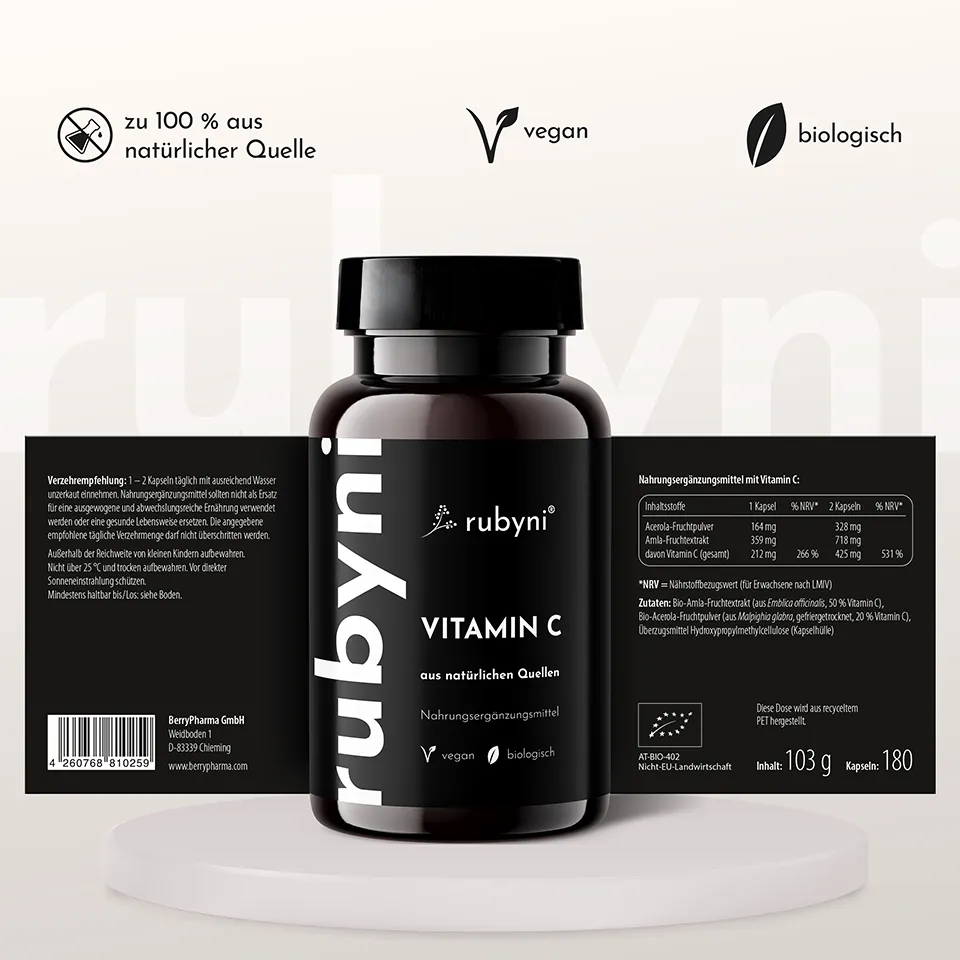
Ingredients: Organic amla fruit extract (from Emblica officinalis, 50% vitamin C), organic acerola fruit powder (from Malpighia glabra, freeze-dried, 20% vitamin C), coating agent hydroxypropyl methylcellulose (plant-based capsule shell).
Each capsule contains 164 mg of acerola fruit powder and 359 mg of amla fruit extract, providing a total of 212 mg of vitamin C—which is 266% of the daily value according to the NRV*.
*NRV = Nutrient Reference Value (for adults, as defined by the Food Information Regulation (LMIV))
Recommended Use: Take one to two capsules per day whole with sufficient liquid—do not take on an empty stomach. Divide the two capsules between two doses. Do not exceed the recommended daily intake.
Note: Dietary supplements should not be used as a substitute for a balanced and varied diet or a healthy lifestyle.
60 capsules €59.90
Includes sales tax; shipping not included



rubyni® Vitamin C from natural sources
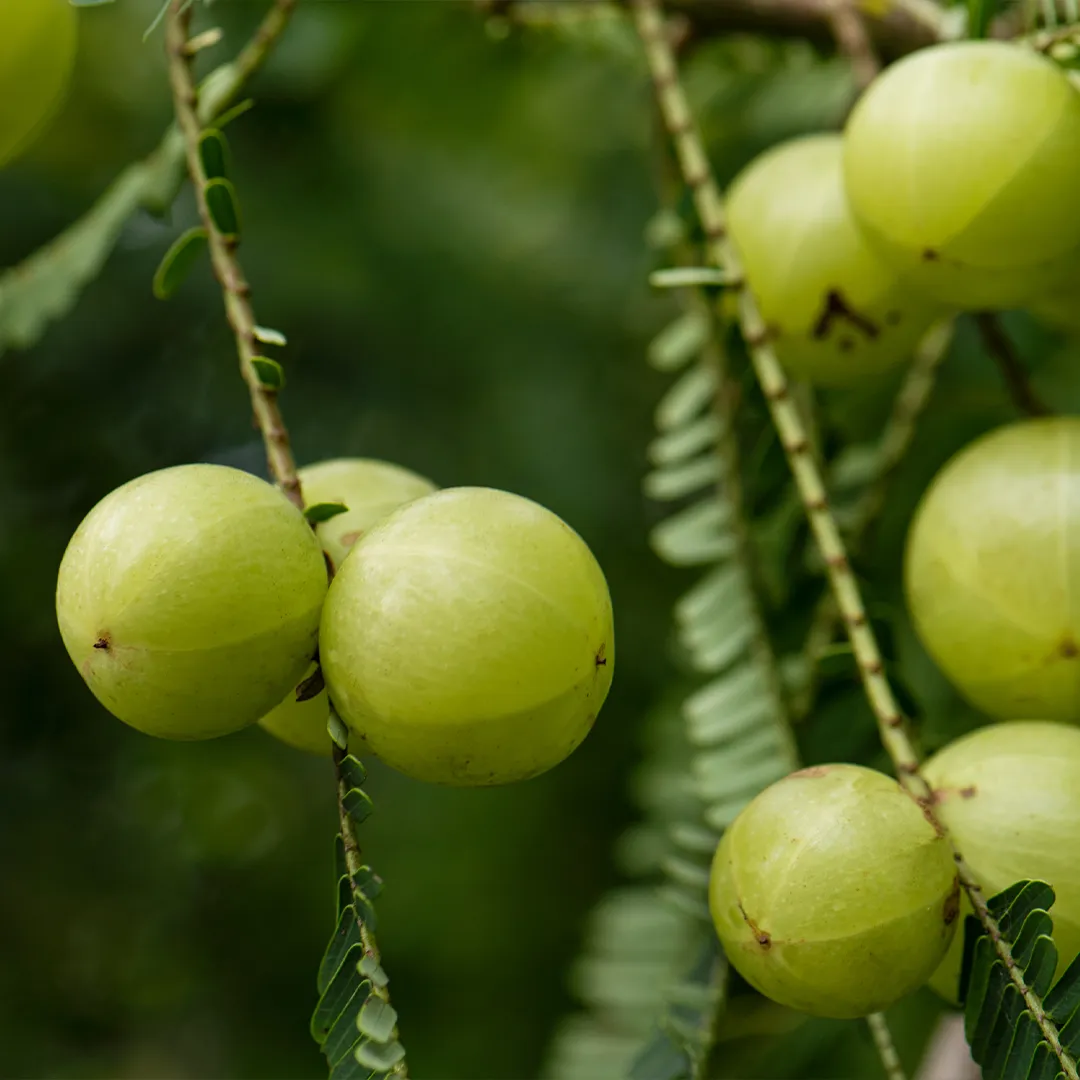
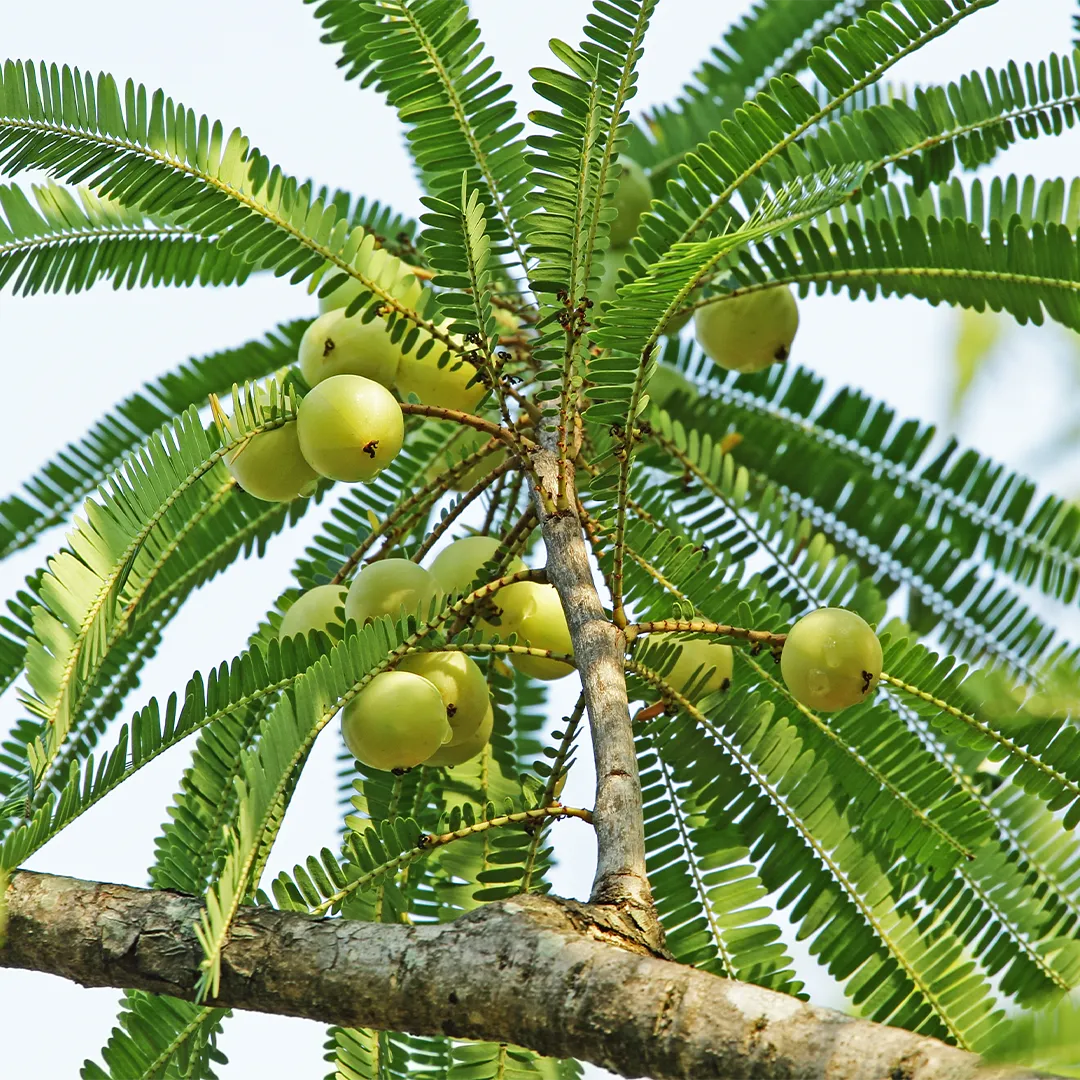
For our rubyni Vitamin C capsules, we use two fruits that are naturally rich in vitamin C: acerola cherries and amla, the Indian gooseberry.
Vitamin C plays a role in many bodily functions. Among other things, it contributes to normal energy metabolism and normal immune system function.1
- Organic amla fruit extract and organic acerola fruit powder with vitamin C
- One capsule contains 212 mg of vitamin C; two capsules provide 425 mg of vitamin C
- vegan, lactose-free, and gluten-free
- 100% organic
- No added preservatives or fillers

How much vitamin C does your body need?
Vitamin C is found in fruits and vegetables, among other things. Your body cannot produce this nutrient on its own. Therefore, you need to regularly consume sufficient amounts through your diet.2 But what exactly does that mean?
The German Nutrition Society (DGE) recommends a daily intake of 95 mg of vitamin C for women. For men, the recommendation is 110 mg per day. If you are pregnant, breastfeeding, or smoking, your vitamin C needs may be higher. Your needs may also vary during periods of intense physical activity or under certain life circumstances.3,4,5
The European Union (EU) specifies a daily requirement of 80 mg of vitamin C for both genders. This is known as the Nutrient Reference Value (NRV for short). This serves as a guideline in the manufacture of dietary supplements when it comes to the dosage of vitamins and minerals.6
Which fruits are particularly high in vitamin C?
What comes to mind when you hear the term “vitamin C”? Most people immediately think of a lemon or an orange. But there are fruits that contain far more vitamin C. These include the acerola cherry and amla, the Indian gooseberry.
Acerola is native to Brazil and is one of the fruits particularly rich in vitamin C. Depending on its ripeness and how it is processed, 100 g of the fruit can contain up to 1,700 mg of vitamin C. Amla also provides several hundred milligrams of this nutrient per 100 g of fruit. By comparison, a lemon contains about 50 mg of vitamin C per 100 g of fruit.7,8,9
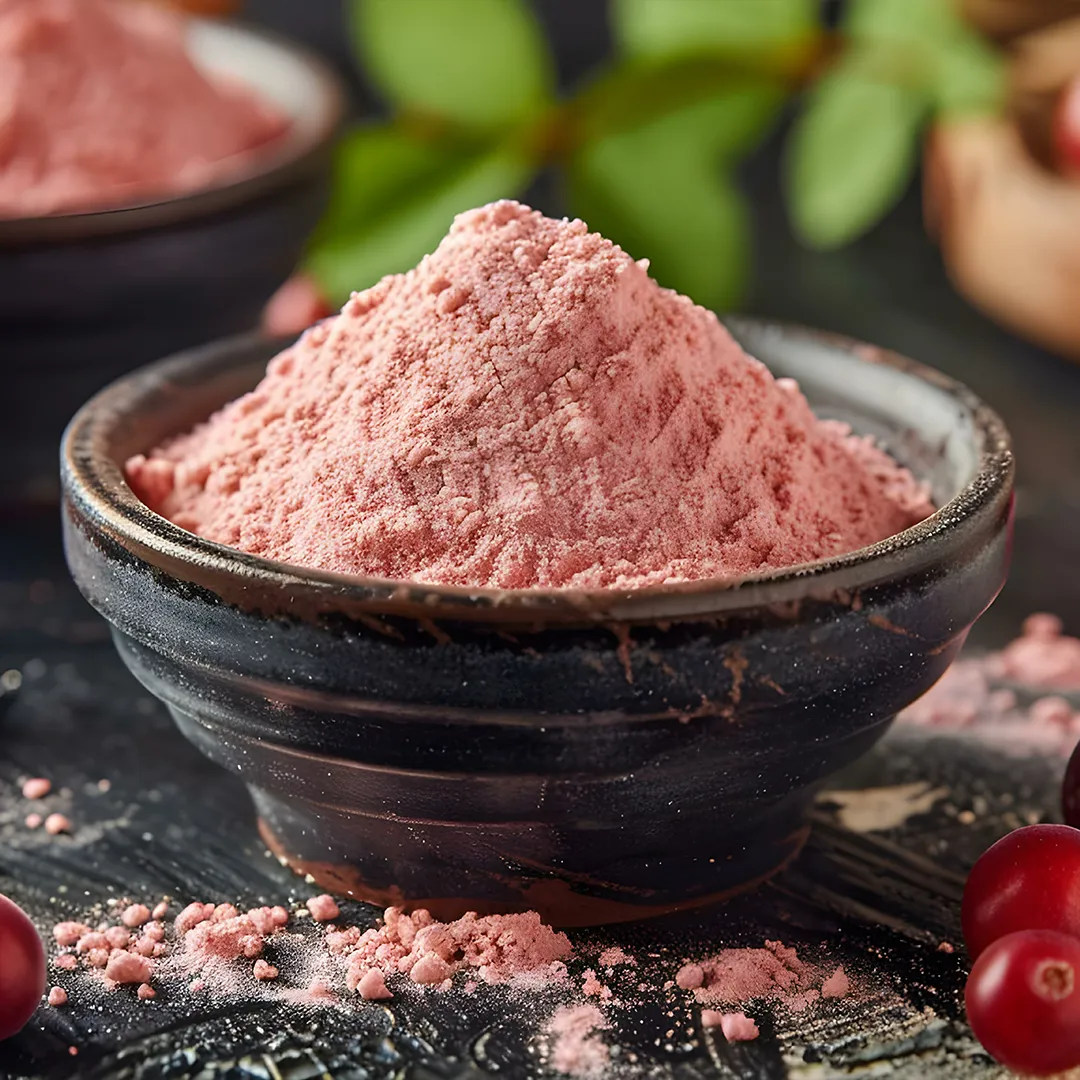
rubyni® Vitamin C—Here’s What’s Inside Our Capsules
One rubyni Vitamin C capsule contains 164 mg of acerola fruit powder and 359 mg of amla fruit extract, which together provide 212 mg of vitamin C. This corresponds to 266% of the daily value for vitamin C according to the Nutrient Reference Value (NRV*).
Two capsules provide 328 mg of acerola fruit powder and 718 mg of amla fruit extract and contain 425 mg of vitamin C, which is 531% of the NRV*.
*NRV = Nutrient Reference Value (for adults, as defined by the Food Information Regulation (LMIV))
rubyni® Vitamin C at a Glance
rubyni Vitamin C is a dietary supplement that contains two different plant-based sources of vitamin C: organic amla fruit extract (from Emblica officinalis) and organic acerola fruit powder (from Malpighia glabra).
We use select fruits from Brazil to make our organic acerola fruit powder. The amla fruit is also known as the Indian gooseberry. Our fruits are grown in the Ooty highlands, among other places—this region in India is known for its amla cultivation.
The vitamin C content is standardized during the processing of the raw materials to ensure that the product has a consistent composition.

Good to Know
Vitamin C: A Nutrient with Multiple Functions in the Body
You’ve surely heard that vitamin C supports the normal function of the immune system. But this nutrient is also involved in other processes in the body. Among other things, it contributes to normal collagen formation for the normal function of blood vessels, bones, cartilage, gums, teeth, and skin. Collagen is the most abundant protein in the human body and, among other things, an important component of connective tissue.1,10
In addition, vitamin C contributes to normal energy metabolism and helps reduce tiredness and fatigue.
Do you follow a vegetarian or vegan diet? If so, it may be a good idea to combine iron-rich meals with vitamin C: Vitamin C increases the absorption of iron from food, especially from plant-based foods such as legumes, oatmeal, or pumpkin seeds.1,4,11
What does vitamin C have to do with oxidative stress?
Vitamin C helps protect cells from oxidative stress. Oxidative stress can be caused by so-called free radicals. These are highly reactive molecules that occur naturally during metabolism or as a result of external factors, such as radiation exposure, and can damage cellular structures.1,12,13
Vitamin C is also important for your nerves: It contributes to the normal functioning of the nervous system and to normal mental function. It also supports the normal production of neurotransmitters. Neurotransmitters are substances that, among other things, transmit signals from one nerve cell to the next.1,14

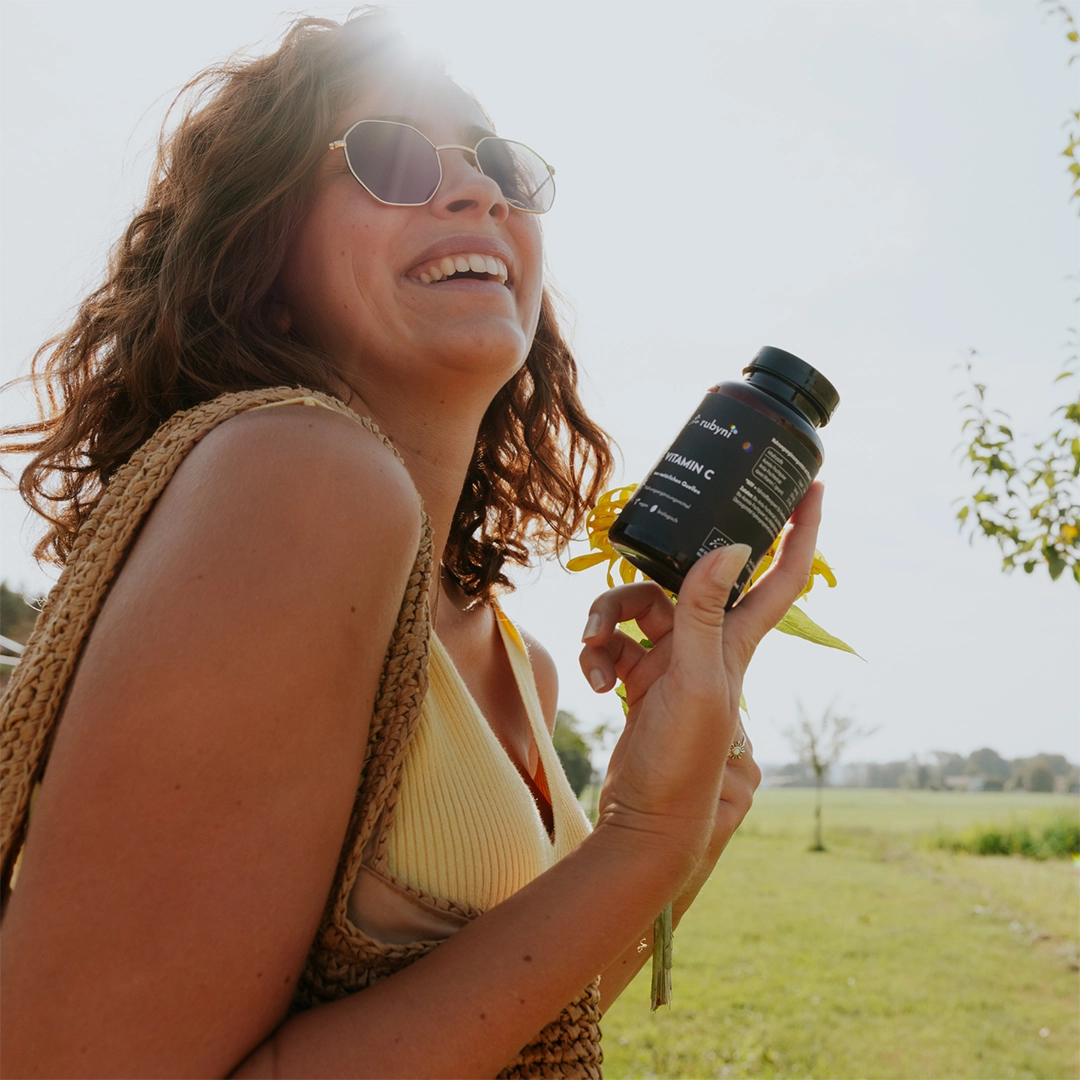
Animals, People, and Vitamin C: Did You Know?
Did you know that most animals can simply produce their own vitamin C? Dogs, cats, and many species of birds produce it in their bodies every day—without needing fruit or dietary supplements.
Humans, however, are one of the few exceptions. Just like monkeys and guinea pigs, we have lost the ability to produce vitamin C on our own over the course of evolution. That is why we must get it regularly through our diet.15
Vitamin C (ascorbic acid) occurs naturally in numerous fruits and vegetables, where it is integrated into the natural food matrix along with other plant-derived compounds. For dietary supplements, vitamin C can either be extracted from such natural plant sources or produced industrially. In both cases, it is chemically the same ascorbic acid—the difference lies in its origin and its incorporation into the natural plant matrix.
What role does vitamin C play in the body (health claims)?
Vitamin C plays a role in numerous normal bodily functions:
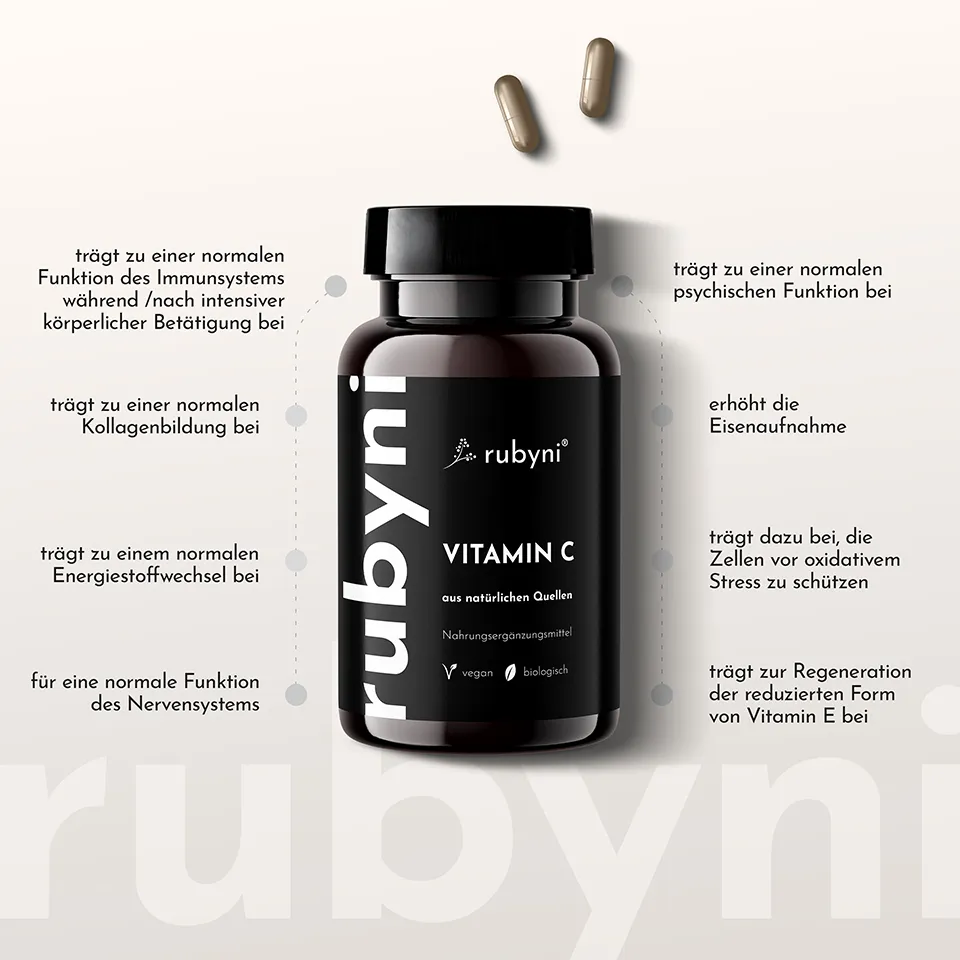
Vitamin C
- contributes to the normal functioning of the immune system during and after intense physical activity*
- contributes to normal collagen formation
- for normal blood vessel function
- for normal bone function
- for normal cartilage function
- for normal gum function
- for normal skin function
- for normal tooth function
- contributes to normal energy metabolism
- contributes to the normal functioning of the nervous system
- contributes to normal psychological function
- contributes to the normal functioning of the immune system
- helps protect cells from oxidative stress
- helps reduce tiredness and fatigue
- helps regenerate the reduced form of vitamin E
- increases iron absorption
*Applies when an additional 200 mg of vitamin C is consumed daily.
What makes rubyni Vitamin C so special?
rubyni Vitamin C contains this nutrient from two plant sources: Our capsules contain organic acerola fruit powder as well as organic amla fruit extract, also known as Indian gooseberry. Both fruits are naturally rich in vitamin C. The vitamin C content is standardized during the processing of the raw materials for our capsules. This ensures a consistent product composition.
How much Rubyni Vitamin C should I take each day?
One rubyni Vitamin C capsule contains 212 milligrams of vitamin C—which is 266% of the daily value for vitamin C based on the Nutrient Reference Values (NRV*). Two capsules contain 425 milligrams of vitamin C, or 531% of the NRV*. We recommend taking one to two capsules per day with plenty of liquid, preferably with a meal. Take two capsules in two separate doses. Do not exceed the recommended daily intake.
*NRV = Nutrient Reference Value (for adults, as defined by the Food Information Regulation (LMIV))
Is Rubyni Vitamin C vegan, gluten-free, and lactose-free?
Yes, rubyni Vitamin C is made from 100% vegan ingredients enclosed in a plant-based capsule shell (made from hydroxypropyl methylcellulose): The vitamin C comes from the fruits of the acerola and amla. All ingredients are vegan, lactose-free, and gluten-free.
What roles does vitamin C play in the body?
Vitamin C contributes to many key bodily functions: It supports the normal functioning of the immune system, contributes to normal energy metabolism, and helps protect cells from oxidative stress. It also plays a role in normal collagen formation. This is important for the skin, bones, cartilage, gums, teeth, and blood vessels.1
References:
1) Commission Regulation (EU) No. 432/2012 of May 16, 2012, establishing a list of permitted health claims made on foods, other than those referring to the reduction of disease risk and to children’s development and health. As of August 20, 2025. https://eur-lex.europa.eu/legal-content/DE/TXT/?uri=CELEX%3A02012R0432-20250820, last accessed on June 18, 2026
2) Federal Institute for Risk Assessment. Vitamin C is not only found in fruits and vegetables. As of. 16.03.2026. https://www.bfr.bund.de/fragen-und-antworten/thema/vitamin-c-steckt-nicht-nur-in-obst-und-gemuese/, last accessed on June 18, 2026
3) German Nutrition Society (DGE). Reference Value: Vitamin C. As of 2015. https://www.dge.de/wissenschaft/referenzwerte/vitamin-c/, last accessed on June 18, 2026
4) German Nutrition Society (DGE). Selected Questions and Answers on Vitamin C. As of 2015. https://www.dge.de/gesunde-ernaehrung/faq/vitamin-c/, last accessed on June 18, 2025
5) Austrian Public Health Portal. Vitamin C. As of October 31, 2024. https://www.gesundheit.gv.at/leben/ernaehrung/vitamine-mineralstoffe/wasserloesliche-vitamine/vitamin-c.html, last accessed on June 18, 2026
6) Regulation (EU) No. 1169/2011 of the European Parliament and of the Council of October 25, 2011. https://eur-lex.europa.eu/legal-content/DE/TXT/PDF/?uri=CELEX:32011R1169&from=EN, last accessed on June 18, 2026
7) Apotheken Umschau. Acerola: The Vitamin C Wonder. As of May 8, 2023. https://www.apotheken-umschau.de/gesund-bleiben/ernaehrung/acerola-das-vitamin-c-wunder-712701.html, last accessed on June 18, 2026
8) Alkandari, Dina et al. Development of a functional food (pan bread) using amla fruit powder. Journal of Food Science and Technology vol. 56,4 (2019): 2287-2295. https://pmc.ncbi.nlm.nih.gov/articles/PMC6443718/
9) Federal Center for Nutrition. Which foods contain the most vitamin C? As of December 22, 2021. https://www.bzfe.de/presse/pressemeldungen-archiv-2024-und-frueher/worin-ist-am-meisten-vitamin-c-enthalten, last accessed June 18, 2026
10) DocCheck Flexikon. Collagen. As of April 22, 2026. https://flexikon.doccheck.com/de/Kollagen, last accessed on June 18, 2026
11) Apotheken Umschau. Eating an Iron-Rich Diet: How to Do It. As of January 10, 2022. https://www.apotheken-umschau.de/gesund-bleiben/ernaehrung/eisenreich-essen-so-gelingt-es-719507.html, last accessed on June 18, 2026
12) DocCheck Flexikon. Oxidative Stress. As of July 14, 2024. https://flexikon.doccheck.com/de/Oxidativer_Stress, last accessed on June 18, 2026
13) Specialist Medical Knowledge. Oxidative Stress. As of May 8, 2026. https://medicoconsult.de/oxidativer-stress/, last accessed on June 22, 2026
14) Austrian Public Health Portal. Neurotransmitters. As of https://www.gesundheit.gv.at/lexikon/N/lexikon-neurotransmitter.html, last accessed on June 18, 2026
15) Drouin G et al. The Genetics of Vitamin C Loss in Vertebrates. Curr Genomics. Aug. 2011; 12 (5): 371–378. https://pmc.ncbi.nlm.nih.gov/articles/PMC3145266/